Mapping the Order Flow in Your Restaurant and Analyzing Bottlenecks
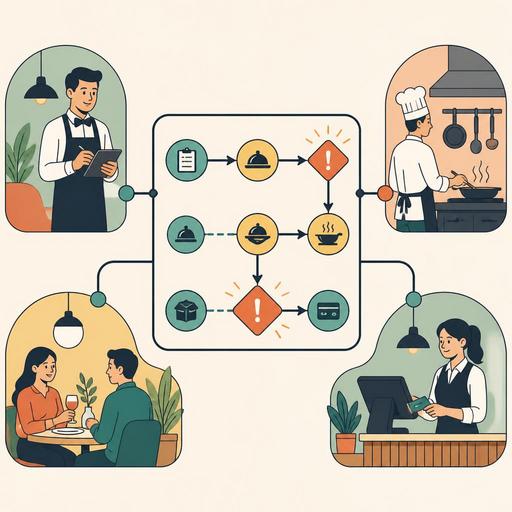
Mapping the order flow in your restaurant is one of the most practical ways to see why delays happen during peak hours, at which point errors are produced, and where your team is spending unnecessary effort. Many businesses define the problem simply as "the kitchen is slow," "service can't keep up," or "the register is jammed." Yet the real problem is most often hidden in an invisible link of the chain that runs from the moment an order is first taken to the moment it reaches the table. When you map the order flow, you can make decisions based on the process rather than on guesswork, and improve both the customer experience and operational efficiency at the same time.
In this article, we will cover how to map the order flow, at which stages bottlenecks most often hide, and the concrete actions restaurant owners can apply on the floor right away. The goal is not only to move faster; it is also to build fewer errors, a clearer division of tasks, and a more predictable service routine.
Why isn't an order flow map only for large restaurants?
When order flow mapping comes up, the first thing that may come to mind is multi-location or high-volume businesses. Yet it is just as valuable for a small cafe, a neighborhood restaurant, a takeaway-focused kitchen, or a busy lunchtime eatery. Because bottlenecks don't arise only from high volume; they arise from an unclear process.
For example, in a 12-table business where the server takes the order on paper, relays it to the register, the register passes the information to the kitchen verbally, and the kitchen can skip an item when things get busy, the problem is not scale but process design. Similarly, in a business that uses a QR menu, even though the order arrives digitally, delays still continue if the division of tasks among kitchen stations isn't clear. In other words, digital tools alone are not the solution; they create value when combined with the right flow design.
How do you map the order flow?
The first step is to make all the touchpoints the order passes through visible. The healthiest approach is to do this separately for dine-in, takeaway, and pickup processes. Because each channel may have a different bottleneck.
1. Clarify the start and end points
The start of the map could be "the customer looked at the menu"; the end could be defined as "the item was served" or "payment was completed." For some businesses, the "customer feedback received" stage can also be included in the process. What matters is clearly defining where you are looking from and to.
2. Write down every step one by one
- The customer reviews the menu
- The order is taken by the server or entered through the QR menu
- The order arrives at the register or order management screen
- It is routed to the relevant station in the kitchen
- Preparation begins
- Checking and completion are carried out
- It is handed over to the service staff
- It is served to the table
- If needed, additional requests and revisions are processed
- The check and payment process is completed
When you draw up this list, note not only the official flow but also the real flow on the floor. Because most bottlenecks emerge not in the procedure but in daily practice. Instead of "this is how we normally do it," ask "how do we actually do it?"
3. Mark the waiting and rework points
Add two critical notes next to each step: waiting and rework. Waiting refers to the moments the order sits in the queue; rework refers to situations that were entered incorrectly, prepared incompletely, or need to be asked about again. Bottlenecks most often become visible under these two headings.
For example, if drinks come out quickly while main courses are delayed, the problem may not be cooking time; perhaps the side dish is being confirmed at the last minute. Perhaps the kitchen notices special notes too late. Mapping reveals these invisible points of friction.
Where do bottlenecks most often hide?
In restaurants, the place where the order flow gets stuck is not always the busiest-looking section. Sometimes a quiet confirmation step, sometimes missing menu information, and sometimes the style of internal communication slows down the entire process.
Uncertainty in the menu decision process
If the customer struggles to understand the menu, the time it takes to take the order grows longer. Especially with items that have variations, if the cooking level, sauce choice, side-dish alternative, or allergen information isn't clear, the server stays at the table longer. This lowers the order-entry speed even if dining-room capacity increases. In digital menus, presenting descriptions, visuals, and product options in an organized way can reduce the friction at this stage.
The order reaching the kitchen incompletely or in a scattered way
Paper tickets, verbal relay, or information split across different screens create areas in the kitchen that require interpretation. When notes like "no onions," "mild spice," "for a child," or "soup first, then the main course" aren't standardized, the team starts asking each other questions. These questions seem brief, but they disrupt the service tempo. That is why it is critical for order management to move in a single flow and for notes to be visible and clear.
Unbalanced workload distribution across stations
The grill, hot, cold, dessert, and beverage stations can experience different levels of intensity at the same time. If one station is ready while another keeps things waiting, the order as a whole is delayed. For example, the burger is ready but the fries station is behind; as a result, the customer receives the entire order late. For this reason, you need to look not only at the total preparation time but at the station-based flow.
The invisible waiting in service handoff
Getting the item that comes out of the kitchen to the table is also a separate process. If the service staff is at another table at that moment, the item waits on the counter. Especially with dishes that need to be served hot, this waiting also affects quality. When there is no clear responsibility defined between the kitchen pass and the service handoff, the business thinks "the kitchen is slow to plate" when in fact the problem may lie in dining-room coordination.
A bottleneck analysis method you can apply on the floor right away
Before turning to complex software for deep analysis, you can use a lean method you can apply during a single shift. The goal should be to see the truth without putting the team on the defensive.
- Pick a single service window: For example, Friday evening between 7:00 and 9:00 p.m.
- Choose a product group: Such as burgers, kebabs, breakfast plates, or takeaway orders.
- Note each step with a timestamp: Order taken, sent to the kitchen, preparation started, came out, served.
- Classify the waiting orders: Awaiting confirmation, awaiting preparation, awaiting a courier, awaiting service.
- Find the recurring snag: If the same problem appears more than three times, it is not an exception but a process problem.
What matters here is examining the flow, not the employee. The question "which step was delayed because it depends on a single person?" is more useful than "who fell behind?" This perspective more accurately defines both the training need and the process improvement.
How does digitalization gain meaning in the order flow map?
Digitalization is valuable only if it makes a visible process more measurable and manageable. Otherwise, it merely moves analog chaos onto a screen. For this reason, you need to think of tools such as the QR menu, order management, reservation flow, or POS integration not separately but as parts of a single order journey.
For example, thanks to the QR menu, misunderstandings at order entry can decrease; with the order management screen, kitchen notes can be communicated more clearly; thanks to POS integration, the need to re-enter data on the register side can drop. Similarly, when the table plan becomes more predictable with reservation information, dining-room density can be better balanced against order-taking capacity. The critical point here is to use each tool knowing exactly which friction in the flow it solves.
For many restaurants, the biggest gain is moving from the feeling that "there's a problem" to the clarity of "the problem occurs at this step." Without this clarity, adding staff, trimming the menu, or cutting campaigns most often does not produce a lasting solution.
Conclusion: Fast service starts with a visible process
Mapping the order flow is one of the most effective ways to look at restaurant operations from the outside. Bottlenecks most often hide not in the noisiest place, but in recurring small waits, in incomplete information flow, and in poorly defined responsibilities. When you make the process visible step by step, you can more easily determine where standardization is needed, where you will benefit from digital support, and which tasks need to be redistributed.
In short, a well-run order flow means not only faster service; it means more consistent quality, less stressful team management, and stronger customer satisfaction. Digital solutions like Restomas can offer practical support for businesses that want to increase this visibility and make the order journey more orderly.
