Smart Queue Logic for Managing the Peak-Hour Order Line in Restaurants
The smart queue logic that manages the peak-hour order line in restaurants is a critical management approach that prevents operations from falling apart, especially during lunch service, weekend evening rushes, and promotional hours. The problem is often not an increase in the number of orders but orders loading onto the same station, the same preparation capacity, at the same time. For this reason, a good queue structure clarifies which order will be processed first, which will be prepared in parts, and which one's delay will disrupt the entire flow. For restaurant owners, the real issue is not only speed; it's kitchen balance, service consistency, customer expectations, and staff being able to work without making mistakes.
During busy hours, the problem is not the number of orders but incorrect sequencing
At the root of the chaos experienced during crowded hours there is usually a single mistake: orders drop into the kitchen in the order they arrive, but the production reality doesn't match that. For example, if drinks and desserts that can be prepared in two minutes are queued with the same logic as grilled products requiring long cooking, both the wait time grows longer and the service tables become disorganized. In the end, one table waits for drinks while another is delayed for the main course, takeaway orders clash with in-house service, and the team, under pressure, begins to put out incorrect orders.
This is where smart queue logic comes in. The goal is not to blindly apply the "first come, first served" approach; it's to manage the order according to variables such as preparation time, station load, service type, and delivery expectation. This approach makes a major difference, especially in businesses managing dine-in, grab-and-go, and takeaway orders at the same time.
Let's consider a concrete example: three orders arrive within the same minute. The first is a single coffee and croissant, the second is a burger menu for four, the third is a hot meal package for courier delivery. Putting these three orders in a single queue looks fair in theory; in practice, it's inefficient. If the coffee-and-croissant order waits for minutes, the guest experiences unnecessary dissatisfaction. If the courier order is delayed, the delivery time slips. And the four-person table order, if managed without being split across different stations, creates congestion in the kitchen.
How should the queue algorithm that works in a restaurant be conceived?
The term "algorithm" here means clear decision rules far more than complex software code. A good system should work in a standard way without putting too much burden on the initiative of the staff member taking the order. To do this, the following logics should be evaluated together:
- Priority by preparation time: Products completed in a short time should not get lost behind products with long production times.
- Station-based balancing: The grill, fryer, bar, and cold prep do not have the same capacity; the order load should be distributed accordingly.
- Distinction by service type: Dine-in, grab-and-go, and takeaway orders do not carry the same delivery pressure.
- Splitting bulk orders: A large order should flow not as a single block but split across production stations.
- Wait-threshold alerts: Orders that exceed a certain duration should be marked visibly.
For example, in a quick-service burger restaurant, the bar station may be free while the grill is backed up. In such a situation, the system can have drinks and side items prepared early and match them up close to the main product's output. On the fine dining side, the opposite applies: certain items can be deliberately held so that all products flow to the table at the same time. In other words, the right queue logic is shaped according to the restaurant's concept.
Why does splitting orders into flows instead of a single queue make a difference?
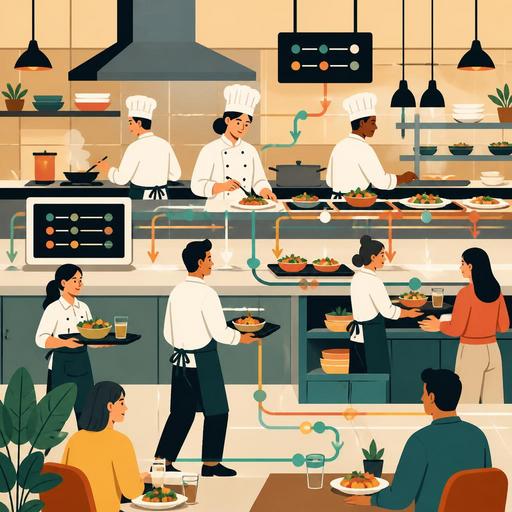
Many businesses try to manage orders with a single screen, a single list, or a single printer flow. This method gets by when it isn't busy; but during peak hours it produces a bottleneck. The healthier method is to split the order into flows suited to operational reality.
1. Production flow
Which stations will the order affect in the kitchen? If the grill, fryer, salad, dessert, and drink sections carry separate loads, each should see its own queue. This way, congestion at one station doesn't make another invisible.
2. Delivery flow
Table service and takeaway orders should not be managed with the same logic. In a takeaway order, delivery timing can be critical; in table service, the course sequence and the guest experience come to the fore. If this distinction isn't clear on the order screens, the team gets confused about who to keep up with.
3. Priority flow
Some orders require special attention: a children's menu, a product with an allergen note, a package awaiting a courier, a pre-ordered table, a drinks-only request, and so on. Even if these orders appear in the normal sequence, their operational priority may differ.
Digital order management provides an important advantage here. While orders coming from the QR menu, table-based requests, and orders dropping in from different channels are consolidated in one center, if correct tagging is done on the back end the team can answer the question "which order got stuck where?" faster. The value of platforms like Restomas emerges exactly here: not just receiving the order, but making it visible and manageable in a way suited to the business's flow.
Actionable queue rules for restaurant owners
If orders pile up during busy hours in your business, table turnover slows down, or staff constantly argue about "which order comes out first?", you can put the following rules into effect:
- Tag the menu by preparation time. Create fast, medium, and long preparation categories. This classification becomes the basis for determining order priority.
- Find the most-clogged station. The problem is often not the whole kitchen but a single bottleneck. Is it the grill, the coffee bar, or the fryer? Build the queue logic around this station.
- Break up large orders. Instead of managing a single eight-person check as one block, distribute it station by station; but have an expeditor or responsible staff member manage the service consolidation.
- Give takeaway and dine-in orders separate visibility. Even if they're on the same screen, their delivery targets should be tracked in a different color or with a separate tag.
- Set a wait-time alert. Once a certain threshold is exceeded, let the order's visibility increase. This way, orders quietly running late aren't overlooked.
- Evaluate menu engineering together with queue data. Identify products that sell a lot but lock up the line; redesign the recipe, the pre-prep, and the presentation standard.
For example, in a cafe serving breakfast, if omelets, toast, coffee, and freshly squeezed products all peak at the same time, the problem may not only be the number of staff. Perhaps the fresh-squeeze drink bar is locking up and the entire table order is being delayed unnecessarily. In such a case, supporting some products with pre-prep, moving others to a separate station, or putting drinks in a different queue on the order screen can be more effective.
The right system clarifies the decision more than it speeds up staff
Many restaurant owners look for the solution in more staff. Yet during busy hours the real loss is often not a lack of physical speed but decision uncertainty. The server can't track whether the order reached the kitchen, the kitchen can't tell which ticket is critical, and the register notices the delay of a takeaway order at the last moment. This uncertainty wears out even an experienced team.
A well-designed digital flow is more valuable than telling staff to "be faster"; because it clarifies the question "what do you need to do right now?" When it's visible which channel the order came from, which station it dropped into, how long it has been waiting, and its delivery priority, the team works more consistently with less verbal coordination. This both reduces the error rate and makes the estimated times given to the guest more realistic.
In conclusion, the way to prevent order chaos during busy hours is not a magical boost in speed but designing the queue intelligently. Managing orders according to their operational impact rather than their arrival order; balancing the kitchen load; making delivery pressure visible; and tracking the bottleneck with data preserves the sense of control even in the restaurant's busiest moments.
Restomas can help simplify the steps of digitization for restaurants that want to make their order flow more visible and manageable.
