How Can a QR Contactless Payment Investment Pay for Itself the Same Day in Restaurants?
QR contactless payment is not just a modern payment method in restaurants; it's an operational tool that directly affects service speed, table turnover, and team efficiency. That's why many business owners ask, “how long until the investment pays for itself?” The critical point here is to evaluate the return not only through device cost or commission math, but through time saved, fewer errors, faster collection, and a smoother guest experience. In a properly designed system, the move to QR contactless payment can, for some businesses, start producing a noticeable benefit within the same day.
Why does QR contactless payment directly affect revenue and operations?
In a restaurant, the moment of payment is often the slowest link in the service chain. The guest asks for the check, a staff member brings the bill, the POS device is hunted down, the device comes to the table, a connection is awaited, the payment is completed, and the receipt process is handled. Especially during peak hours, this delay of a few minutes — though it looks small for a single table — can turn into a serious bottleneck across the whole dining room.
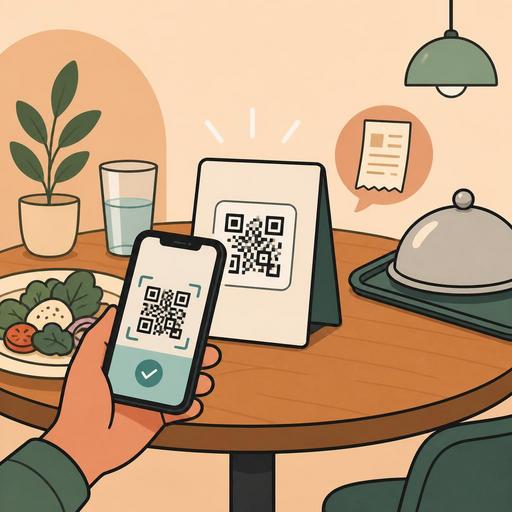
QR contactless payment shortens the process at this point. The guest sees their check via the QR at the table, completes the payment from their own phone, and the back-and-forth traffic the staff make to collect payment is reduced. As a result:
- The time the server spends between the register and the POS device drops.
- The time it takes to close a table shortens.
- During peak hours, the exit traffic flows more smoothly.
- The dissatisfaction caused by waiting for the check decreases.
- Staff can focus on service quality instead of carrying payments around.
What matters here is that the technology works not on its own, but as part of the digital flow built from ordering to collection. When the QR menu, order management, and payment flow are disconnected from one another, the gain stays limited. When they're connected, the business gains a more visible speed advantage.
How should “a 4-hour return” be understood?
This phrasing doesn't mean every restaurant moves into direct financial profit within four hours. The more accurate approach is this: Do operational effects that make the value of the investment visible appear within the first few hours? For most quick-service operations, busy cafés, food-court businesses, and restaurants with high table turnover, the answer is yes.
For example, consider a business with a very busy lunch service. In the normal setup, a significant portion of the servers' time goes to collecting payments as much as taking orders. When QR payment comes into play, the same team, on the same shift, can respond to more tables faster. This creates the following effects:
- The number of tables waiting to pay decreases.
- The time to clear a table shortens.
- The customer waiting in line is seated faster.
- The mental load on staff drops, and the chance of error decreases.
Let's give a concrete example: in a small but busy breakfast spot, when customers who don't want to go to the register close their check from the table, congestion noticeably decreases, especially at weekend exit times. Similarly, in a burger restaurant managing takeaway and dine-in traffic at the same time, digitalizing the payment process eases the crunch at the register. The return here sometimes shows up as direct additional sales, sometimes as faster table cycles, and sometimes as more efficient use of staff.
For the fastest benefit, which processes should be set up together?
QR contactless payment provides a benefit even when set up on its own; but for the fastest return, the surrounding processes also need to be organized. The most common mistake restaurant owners make is adding the new payment method on top of the existing fragmented flow. Yet the real efficiency comes from simplifying the process.
1. Check viewing must be clear
The guest should see the check they're paying in a clear, understandable, and up-to-date form. The product name, quantity, any add-ons, and the total amount shouldn't be confusing. Ambiguity lowers payment speed.
2. The table-code match must work flawlessly
It's critically important that the QR code matches the correct table. The wrong table's check, the wrong product list, or mixed-up bills cause a loss of trust. For this reason, the table plan must be tested before going live.
3. Staff must be trained on the new flow
The server's role doesn't disappear; it changes. They're no longer the person carrying the payment, but the one who manages the process and provides support when needed. Even saying “you can pay via QR” at the right moment speeds up adoption.
4. Kitchen and floor data should be considered on the same screen
When payment information can be read together with the order and table status, managers see the dining-room flow better. Especially on busy shifts, it becomes faster to understand which tables are close to closing and which tables are waiting.
At this point, having modules like the digital menu, order management, and reservation work within the same operational logic provides a serious advantage. Because the restaurant's problem is often not just collecting payment; it's managing the table visibly from start to finish.
5 mistakes made during the transition and their practical solutions
The reason QR contactless payment setups appear to fail is usually not the technology, but implementation mistakes.
- Mistake: Putting the QR code on the table without informing the staff.
Solution: Give a short use-scenario training before each shift. - Mistake: Leaving the menu, order, and payment flow disconnected from one another.
Solution: Make sure the guest moves through a single flow. - Mistake: Assuming only the young customer base will use it.
Solution: Keep an alternative payment option, but make QR payment visible. - Mistake: Going live without testing the internet infrastructure.
Solution: Be sure to check the in-house connection quality before peak hours. - Mistake: Measuring success only by comparing commissions.
Solution: Also track metrics like table-closing time, payment-wait complaints, and staff time.
The last item is especially important. In restaurants, some investments pay off not directly on the register receipt, but in operational relief. And that relief becomes noticeable within just a few services.
What should a restaurant owner do today? A 7-step transition plan
If you're considering moving to a QR contactless payment system, approach the topic not as a technology purchase, but as service-flow design.
- Find the bottleneck first: Is the problem a queue at the register, waiting for payment at the table, or insufficient staff?
- Analyze the busiest service: Determine in which time window — lunch, dinner, or weekend — the payment process gets clogged.
- Pilot in a small area: Test it on a specific group of tables before rolling it out across the whole dining room.
- Standardize the staff's phrasing: Clarify how the system will be explained to the guest.
- Physically check the table codes: Make sure the QR labels are readable, clean, and in the right place.
- Measure in the first week: Observe the time between asking for the check and completing the payment.
- Combine the data with other processes: Try to monitor the order, table status, and collection flow from a single place.
This approach helps you avoid the “we set it up but no one uses it” problem. Because when customer behavior, staff habits, and the dining-room flow are handled together, digital payment is adopted naturally.
Conclusion: The real gain is speed, visibility, and control
The return on moving to a QR contactless payment system shouldn't be measured only by how quickly you recoup the device or software cost. For a restaurant, the real value is reducing friction at the moment of payment, speeding up the table cycle, using staff time more efficiently, and offering the guest a smoother experience. For this reason, in some businesses the impact of the investment is felt clearly even in the first busy service.
Digitalization isn't about adding a single tool; it's about connecting the business's most critical touchpoints to each other. When the QR menu, order management, table tracking, and payment flow come together within the same operational logic, the restaurant owner gains not just faster collection, but a more manageable service structure.
Restomas can offer a simple starting point for restaurants that want to set up this transition — from the QR menu to the order and operational flow — in a more organized way.
