A 4-Hour Payback Plan for the QR Payment Transition in Restaurants
The QR payment transition does not mean simply adding a new collection method in restaurants; it is an operational decision that affects order flow, table turnover speed, staff time, and the guest's check-closing experience all at once. For this reason, the phrase "4-hour payback" should be considered not just as an instant revenue increase against device cost, but as the combined effect of the time, labor, and service-flow gains that emerge within the same shift. A correctly designed QR payment flow can create a visible difference, especially during busy service hours, by reducing trips to and from the register and shortening the ask-for-the-check, wait, and pay chain.
What does a 4-hour payback mean?
For a restaurant owner, a fast return on investment usually does not come from a single line item. With systems like QR payment, the payback emerges through the recovery of minutes lost within the same service period, faster table closing, less payment-waiting stress, and staff devoting more time to their real job: service quality. In other words, the key question here is as much "How much is the commission or setup cost?" as it is "What frictions am I eliminating in service today?"
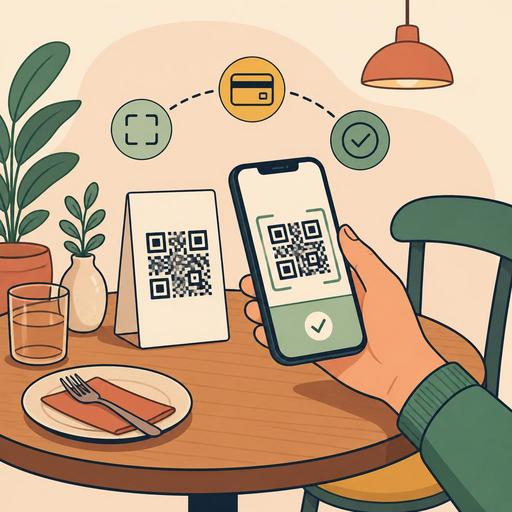
Imagine a concrete example: during the lunch rush, a table raising a hand to ask for the check waits for the server's available moment. The server brings the check, the POS device is at another table or its battery is low, and they wait again. After the card transaction, the receipt process is completed. In a QR payment flow, however, the guest reaches the check screen from the menu or from the code on the table, completes the payment from their own phone, and the table is ready to be cleared. The gain here is not just seconds; it is the reduction of all the breaks in between.
That is why, when calculating the payback, you need to evaluate not just the increase in sales but the following items together:
- Shortening of the time between asking for the check and completing payment
- Reduction of the repeated table visits a server makes to collect payment
- Elimination of waiting for a POS device or a register queue during busy hours
- Improvement in table turnover speed
- Reduction of dissatisfaction caused by delays at the payment stage
Where does the fastest gain appear?
The impact of QR payment does not start at the same point in every business. Quick-service restaurants, cafes, food court locations, lunch-traffic-heavy local eateries, and venues that are busy on weekends generally see the first effect faster. Because in these businesses, the bottleneck is often not in the kitchen, but at the check-closing stage, the final step of the order.
The gain becomes more visible especially in the following scenarios:
1. Tables with short sit-down sessions
At venues selling coffee, dessert, bowls, burgers, or lunch menus, the guest does not want to sit for a long time. They want to sit down quickly and leave quickly. At these kinds of places, shortening the payment process by even a few minutes can translate into more table cycles by the end of the day.
2. Shifts where staff juggle multiple roles
At small-team businesses, the same person serves, watches the register, and helps with takeaway prep. Because QR payment pulls payment collection out of this chaos, it helps staff work without their attention being divided.
3. Check-splitting and repeated payment requests
At tables of friends, office teams, or families, the request "let me pay for what I had" slows down the service flow. Digital payment screens can help manage this process more clearly and with fewer errors. The time gained in such moments makes a serious difference during busy hours.
How do you plan a 4-hour pilot?
The best way to understand the impact of the QR payment transition is not to convert the whole restaurant at once, but to first run a controlled shift pilot. A four-hour test shows you staff reaction, guest behavior, and operational effects alike.
- Choose a busy service window. A time slot with payment intensity, such as lunch service or late-afternoon coffee traffic, is the most accurate test area.
- Turn certain tables into the pilot area. Activate QR payment not across the whole dining room, but for example in a specific section. This makes comparison easier.
- Prepare staff with a one-sentence explanation. Instead of complex training, clarify how to guide the guest: "If you like, you can pay your check quickly from the table via QR."
- Track three measurements. Time to ask for the check, time to complete payment, and table-clearing speed. Noting these even observationally provides a meaningful first data set.
- Record guest questions. Questions like "Is it safe?", "Can I get a receipt?", "Can I also pay cash?" let you see common objections.
The aim in this pilot is not to show off technology, but to reduce friction. If the team presents QR payment as an extra workload, the expected effect stays low. But if they explain it as a convenience that solves the check-waiting problem, adoption speeds up.
For a successful transition, payment alone is not enough: menu, check, and integration must work together
It is hard for QR payment to be efficient on its own. The guest should first see clearly what they ordered, encounter no surprises on the check, and have the post-payment process flow smoothly. For this reason, the QR menu, order management, and payment experience need to be in harmony with one another.
For example, if product names, add-on options, or the price flow are not clear in the digital menu, objections can arise at the payment stage. Similarly, if the check does not proceed in sync on the kitchen and dining-room side, the guest may see a different total on the payment screen. This turns a system that is supposed to add speed into a point of dispute.
Here is where the real power of restaurant digitalization emerges: when the QR menu, order flow, and payment come together in a single operational logic, the team intervenes manually less. The value of platforms like Restomas becomes clear precisely at this point; instead of offering just a QR code, consolidating menu updates, order flow, and the digital service experience into a single structure makes it easier for payment to truly become smooth.
5 practical decisions that speed up the return on investment
The common problem of businesses that switch to a QR payment system but fail to see results is usually not the technology choice, but implementation details. The following steps speed up the payback:
- Place the QR code in a spot that is visible but not intrusive. Materials that get lost on the table or wear out reduce the usage rate.
- Standardize the first sentence. When every server explains it differently, the guest gets confused. A short, reassuring phrase should be adopted.
- Don't remove the cash and card option entirely. Keeping alternatives during the transition period reduces resistance.
- Monitor the moment of check closing. Where does the most delay occur: asking for the check, finding the POS, or a split payment? Target these points first.
- Get feedback from the team at the end of the shift. The most accurate operational improvement comes from the staff using the system in the field.
In a concrete scenario, imagine a cafe with heavy lunch traffic. When payment is completed at the table instead of guests getting up to queue at the register, the exit area eases up, staff focus on service rather than directing people, and the time to prepare a table for an incoming guest gets shorter. The payback here is felt not in a single line item, but across the entire dining-room flow.
Conclusion: A fast payback is possible by removing friction in the right place
The QR payment transition is valuable in restaurants not because it is a "trendy technology," but because it reduces unnecessary waiting at the moment of check closing. If, during busy hours at your business, the payment-collection process lowers service quality, keeps staff unnecessarily occupied, or slows down table turnover, the payback may come faster than you expect. To achieve this, first clarify your own bottleneck, then measure the impact with a four-hour pilot, and address the system in the integrity of menu, order, and payment.
Restomas offers a simple and applicable infrastructure to businesses that want to set up the QR menu and digital service flow more systematically in restaurants.
