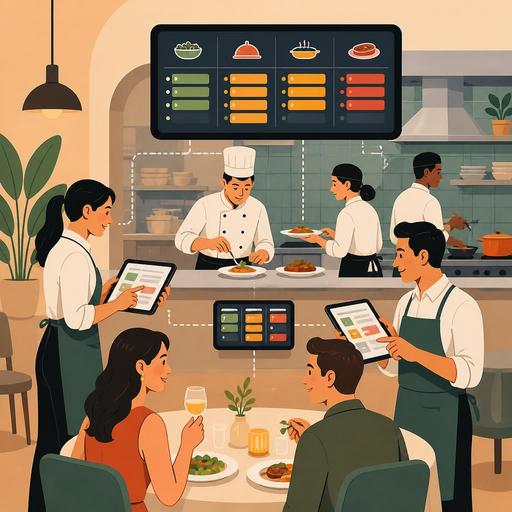
A Queue-Planning Guide to Reduce Order Pile-Ups During Peak Hours in Restaurants
Queue planning that reduces order pile-ups during peak hours in restaurants is a critical topic not only for delivering faster service, but for lowering kitchen stress, preserving table turnover speed, and making customer satisfaction sustainable. Especially during the lunch break, weekend evenings, or campaign hours, if orders arriving at the same time are not managed well, a bottleneck in the kitchen, a communication breakdown in the dining room, and deviations in delivery times become inevitable. At this point, the matter is not just about "being fast," but about intelligently planning which order will be processed when and at which station.
Many businesses try to solve order chaos by increasing the number of staff. Yet the problem is most often in the flow design before the headcount. When four burgers, two salads, three beverages, and takeaway orders arriving at the same time are placed in a single queue, the kitchen naturally gets clogged. Instead, you need to establish queue logic that separates orders by preparation time, station load, service type, and delivery priority. With the right digital infrastructure, this logic becomes visible, and the team knows what to do first not by guessing but through a data-driven flow.
Why does order chaos arise, and why isn't classic queue logic enough?
The most common mistake is managing all orders in a single queue based on arrival order. Although it seems fair at first glance, in restaurant operations this method is most often inefficient. Because the production time of every order is not the same. Sequencing a soup with a well-done steak dish, or a coffee to be served in the dining room with a family pack heading out for delivery, using the same logic misuses kitchen capacity.
For example, three large table orders arriving one after another from the register can unnecessarily delay the single-person quick-lunch orders right behind them. This situation not only extends the waiting time; it also lowers table turnover speed in the dining room. Similarly, because takeaway orders depend on courier timing, they should not be subject to exactly the same priority rule as guests seated inside. The aim here is not to favor one side, but to optimize the business's total flow.
Classic queue logic falls short at the following points:
- It causes items with short preparation times to wait unnecessarily.
- It doesn't balance the load of different production areas such as the grill, fryer, bar, and cold station.
- It handles dine-in, pick-up, and takeaway orders with the same logic.
- It allows a single large order to block the entire line.
- It causes staff to try to resolve momentary priority through verbal communication.
Queue-algorithm logics applicable in restaurants
The word "algorithm" may sound technical; but on the restaurant side, it means prioritizing orders automatically or semi-automatically according to certain rules. There is no single correct model for every business. What matters is determining a logic suited to your menu structure and service model.
1. Prioritization by preparation time
Moving items that can be ready in a short time to the front improves the perception of waiting, especially during the lunch rush. If items such as soup, salad, beverages, or ready desserts are served quickly, the customer evaluates the overall experience more positively. However, if this model is used on its own, long-preparation main dishes can constantly be pushed to the back. For this reason, balancing rules are needed.
2. Station-based parallel queue
In successful kitchens, an order is thought of not as a single piece, but as work broken down into its components. In a burger meal, the bun and patty are prepared at the hot station, the fries at the fryer, and the beverage at the bar. When orders are separated by station, instead of a single screen or a single verbal command, everyone clearly sees their own workload. This way, congestion at one station doesn't lock up the entire kitchen at the same rate.
3. Weighting by service type
The customer seated in the dining room, the pick-up order, and the takeaway order do not carry the same time pressure. For example, the delay of an order whose courier delivery time is approaching can affect platform ratings; for the customer in the dining room, the first-contact time is more decisive. For this reason, it is operationally meaningful to use labeling and priority scores by service type on the order screen.
4. Flowing a large order by splitting it
When a crowded table's order drops into the kitchen all at once, the line can get clogged. Instead, the system can structure the flow so that long-preparation items start immediately while quick-to-complete accompaniments are queued at the appropriate moment. The aim is not to fragment the order, but to spread the workload in the kitchen.
Operational rules that should be established during peak hours
A queue algorithm is not enough on its own; it must be supported with clear rules to be applied on the floor. Otherwise, even a well-designed system loses its effect due to differing interpretations by staff.
- Simplify the menu with a peak-hour mode. If multi-step, highly customizable items create bottlenecks during busy hours, reduce the visibility of these items or standardize their preparation notes.
- Use mandatory labels on the order screen. Information such as table, takeaway, pick-up, allergen note, and courier time should be distinguishable at first glance.
- Define station capacity. Without knowing how many burger patties, pizzas, or coffees can be produced at the same time, a healthy queue cannot be established.
- Separate the start of preparation from the delivery target. Every order does not have to be processed the moment it drops into the kitchen; it should be started at the right moment.
- Create a single source of truth between the dining room and the kitchen. If the information given by the server differs from the status on the kitchen screen, the chaos grows. The whole team should see the same order status.
Here, digital order management provides a significant advantage. When the order coming from the QR menu, the register order, and the orders dropping in from the takeaway channel are gathered into a single flow, the business first sees the total load; then it can distribute this across stations and priority levels. Especially in businesses with more than one order channel, it is difficult to establish healthy queue management without visibility.
Concrete scenarios: Which approach works better in which restaurant?
Let's consider a quick-service burger restaurant. The biggest problem is that meal orders arriving at the same time lock up the grill and fryer line. Here, a station-based parallel queue and getting short-preparation items out early work effectively. Having beverages and sauces flow ready in advance strengthens the customer's perception that "my order is coming."
On the café side, the problem is most often that beverage preparation and kitchen items move at different rhythms. While the coffee bar is busy, toast and dessert orders may wait. In these businesses, the bar and kitchen queues need to be tracked separately, and the two stations synchronized for a single order. Otherwise, the coffee is ready while the food is delayed, or vice versa.
For a family restaurant or a business with a multi-item menu, large table orders are more critical. At this point, the order needs to flow not as a single block, but according to course, station, and serving time. While soups and starters are moved up, the main dishes should be planned according to when the table will be ready. This way, both the kitchen load is balanced and a pile-up at the table is avoided.
A practical 7-day implementation plan to get started
You don't need to wait for a major technology transformation to set up this structure. You can make a difference with a small but disciplined implementation plan.
- Day 1: Review the last week's peak-hour orders; note the most delayed items and stations.
- Day 2: Label menu items as short, medium, and long by preparation time.
- Day 3: Separate orders by service type: table, pick-up, takeaway.
- Day 4: Clarify with the team the capacity each station can handle at the same time.
- Day 5: Decide which items will be simplified for peak hours.
- Day 6: Make the priority labels visible on the order screen or operations dashboard.
- Day 7: Test the system during a busy shift; observe which orders still cause blockages.
Good queue management means less shouting in the kitchen and less uncertainty in the dining room. Most importantly, the team starts working during peak hours with a system rather than on reflex. For businesses using digital order and operations tools like Restomas, this approach makes it easier to see different order channels in one center and establish a more controlled flow.
