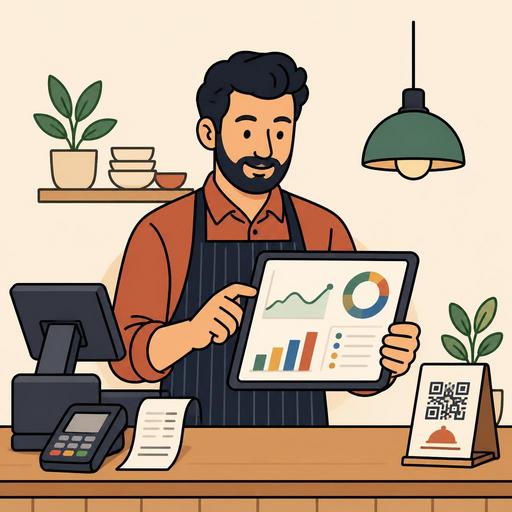
5 Stronger Management Decisions Through Real-Time Cash Visibility in Restaurants
Real-time cash visibility in restaurants is not just seeing today's money in the register; it is being able to read the day's flow of sales, collections, refunds, expenses, and payments within the same frame. In many businesses, the problem is not a lack of profitability but the failure to track clearly when money comes in and when it goes out. For this reason, real-time tracking becomes part of operations management directly, beyond being an accounting task. Especially during busy service hours, supplier payments, staff planning, and a multi-channel order flow, noticing the cash position late can magnify small mistakes.
For a restaurant owner, the real value is not looking at a report at the end of the month; it is being able to make the right decision on time during the day. For example, if the lunch service went strong but the online order channel stayed lower than expected, the evening shift, purchasing priorities, or campaign messaging can be reshaped within the same day. When QR menu, order management, reservation flow, and POS data come together on a single screen, the cash picture becomes more readable rather than more fragmented.
1. You make purchasing decisions based on rhythm, not guesswork
In many restaurants, purchasing decisions are squeezed between two extremes: either too much stock is bought, or a critical product runs out right before peak demand. Real-time cash visibility lets you make the purchasing decision based not only on shortages in the storeroom but on that day's collection rhythm. This way, what is "needed" and what "must be bought today" are separated.
Let's consider a concrete example: a business with strong corporate-customer traffic during weekday lunch service, if it sees the collection flow and pending supplier payments together in the morning, will not treat its meat, beverage, and consumables orders with the same priority. The product groups that turn over quickly and contribute more to the margin come first. This approach protects service without inflating stock.
- Track fast-moving products separately.
- Make mandatory payments visible at the start of the day.
- Stagger supply orders according to service intensity.
- Evaluate menu performance together with the purchasing list.
Digital menu data is also important here. When you can see which product is viewed more, which converts to orders more, and which items start to run out frequently, purchasing is supported not just by kitchen instinct but by data.
2. You notice unnecessary costs in shift and staff planning earlier
Staff cost is one of the most sensitive line items in restaurants. But the question is often not "how many people are working" but "is the right team on the floor at the right time?" Tracking real-time cash and the sales flow moves shift planning away from past habits and closer to current demand.
For example, even if the number of reservations looks strong, if the average check is trending weak, the decision to call in extra staff for the evening service should be reconsidered. In the opposite case, even if floor traffic is at a medium level, if the takeaway channel is rising rapidly, support may be needed on the kitchen and takeaway-preparation side. This difference only emerges when the data is read at the same time.
A practical approach for business managers is as follows:
- At the start of the day, check reservations, the expected order-channel intensity, and the performance of a previous comparable day together.
- Do a short mid-evaluation in the early afternoon.
- Before the evening service, re-match the register flow with order volume.
- Make overtime decisions according to the current picture, not by automatic reflex.
When POS integration, order management, and reservation data are gathered in the same ecosystem, this evaluation is done faster. This way, decision-making time is shortened, and it becomes easier for the manager to stay in control without being detached from the floor.
3. You understand whether campaigns and discounts really work
A campaign can create a surge of traffic, but this does not always mean healthy cash flow. Especially discounted menus, third-party delivery campaigns, or time-limited offers can liven up revenue while weakening collection quality. Real-time tracking makes visible the difference between "a sale happened" and "it benefited the business."
For instance, a campaign launched for a coffee-and-dessert combo may have increased the number of customers in the afternoon. But if at the same hours small non-kitchen expenses are rising, the average basket is not reaching the expected level, or higher-margin products' sales are pushed into the background because of the campaign, then the campaign's messaging or duration should be revised.
At this point, the following questions become critical:
- Is the campaign bringing in new customers, or just selling more cheaply to existing customers?
- Is the average basket rising, or is only the number of transactions increasing?
- Is the campaign balancing capacity at certain hours?
- Is it creating an unwanted shift between online and dine-in sales?
Tracking the products highlighted on the QR menu together with the actual sales in the POS shows more clearly which promotions only attract interest and which genuinely convert into orders and healthy collections.
4. You don't leave supplier, rent, and recurring payment stress to the last minute
In restaurants, financial pressure often arises not from a single big problem but from the inability to manage recurring payments that pile up. When rent, suppliers, staff payments, platform deductions, and various subscriptions all stack into the same period, a business can struggle even if it is profitable. Real-time cash visibility offers the ability to manage this pressure without turning it into a last-day surprise.
For example, if you know that sales are regularly strong on certain days of the week, it becomes easier to structure your payment plan accordingly. But to do this, not only past-month reports but also the current collection rhythm must be visible. This way, you can plan more clearly which payment will be covered by which wave of collections.
The basic aim here is not to defer debt but to align the payment calendar with operational reality. Thanks to a good digital structure, the owner can more easily track the following:
- Today's total collection flow
- Pending recurring payments
- Channel-based sales distribution
- The impact of refunds and cancellations
- Unusual expenses that could disrupt the cash balance
This visibility is even more valuable in businesses with more than one branch, because the problem is often not the total revenue but noticing late which branch's cash rhythm has been disrupted.
5. You build a decision system that strengthens managerial intuition
Experienced restaurant owners often read the floor well. They sense which day will go strong, which product will draw interest, and on which shift a disruption may occur. But in growing businesses, relying on intuition alone is risky. Real-time cash tracking does not eliminate intuition; it builds a decision system that confirms and accelerates it.
For example, a branch manager may know that beverage sales are strong on weekend evenings. But real-time data may show that this sales increase is not reflected in collections to the same degree, or that the cancellation/refund rate rises at certain hours. In this case, the issue is not just increasing sales but improving the service flow and register discipline together.
For a solid management system, the following framework works:
- Establish single-screen visibility: do not let sales, collections, reservations, and order channels scatter separately.
- Set intraday control points: morning, early afternoon, before the evening.
- Flag exceptions quickly: an unexpected drop, high cancellations, an unusual expense.
- Make the decision small and fast: highlighting a menu item, updating a shift, deferring a purchase, and the like.
This is exactly where the real contribution of restaurant digitalization emerges. Instead of disconnected tools, having QR menu, order management, reservation, and POS data meet in the same operational flow makes the financial picture more understandable and daily management more agile.
Conclusion: Seeing cash flow improves not only accounting but also service
Real-time cash visibility in restaurants is not just money tracking; it is a management tool that directly affects purchasing, staff planning, campaign design, and payment discipline. Its biggest benefit is noticing problems during the day instead of seeing them in a report after they have grown. This way the owner makes calmer, more controlled, and more accurate decisions.
For businesses that want to gather data in one place in restaurant operations, Restomas can help make this visibility a natural part of the daily flow.
