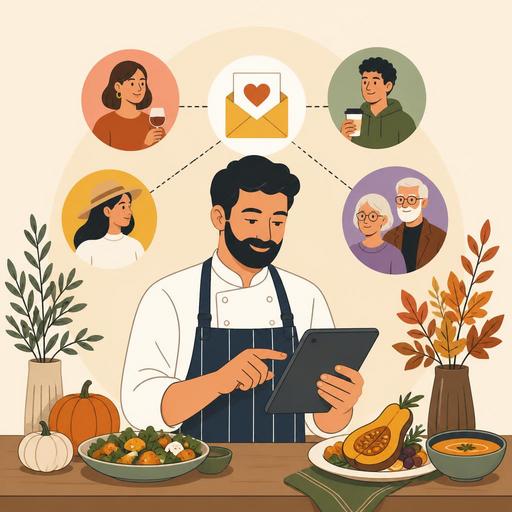
A Segmentation Guide for Seasonal Email Campaigns in Restaurants
Segmentation for seasonal email campaigns in restaurants is a far more powerful method than sending the same discount to everyone. That is because campaigns such as a New Year's menu, a Valentine's Day reservation, an iftar package, a summer-terrace opening, or a weekday lunch menu do not carry the same meaning for every guest. An email that goes to the right person with the right offer and the right timing increases reservations, repeat visits, and campaign efficiency. Moreover, this approach makes not only the marketing side but also operational areas such as kitchen planning, service pace, and stock management more predictable.
Why does a one-size-fits-all email approach fall short in seasonal campaigns?
Many businesses, when preparing a seasonal campaign, send an email to their entire customer list with the same image, the same text, and the same offer structure. While this method seems fast, it usually generates low interest. That is because the expectations of a couple seeking an evening fine-dining experience and an office worker looking for a quick weekday lunch are not the same. Similarly, the hours preferred by families with children, their menu sensitivities, and their reservation behavior also differ.
In seasonal communication, the real aim is not just to make an announcement but to present an offer that looks relevant. For example:
- A limited-tables reminder can be sent to guests who have made reservations in the past.
- A special set menu and a quick-order link can be offered to takeaway-heavy customers.
- Weekend-themed content can be prepared for the brunch-loving crowd.
- Relevant seasonal products can be suggested to guests who frequently consume certain product categories.
This approach turns the campaign from merely a marketing message into communication based on customer behavior.
The most functional email segmentation model for restaurants
Segmentation does not have to be complex. For restaurants, the model that works best in practice is to divide the data you have into a few main groups aligned with operations. What matters here is not opening dozens of segments but creating actionable ones.
1. Segmentation by visit behavior
Separating guests by last visit date, visit frequency, and average spending tendency is quite functional. Instead of sending the same message to a guest who has not come in a long time and a regular guest, you need to design with different goals. Early access is more suitable for regulars, while a win-back offer is more suitable for those who have not come in a long time.
2. Segmentation by order channel
Some customers like to come to the restaurant and have an experience; others are more active on the QR menu or online-ordering side. Order-channel information directly affects the type of offer. A reservation call can be offered to dine-in-focused customers, while an easy re-order flow can be offered to takeaway-focused customers.
3. Segmentation by day and time preference
Sending a Valentine's Day evening-menu email to an audience that works intensively during lunch hours may not be enough on its own. By contrast, an emphasis on limited tables and the experience may be more effective for guests who come on weekend evenings. This segment is especially valuable for businesses that have reservation data.
4. Segmentation by interest and menu preferences
Those who love meat-heavy menus, breakfast regulars, dessert orderers, those who make special-occasion reservations, or those who prefer non-alcoholic beverages respond to different messages. The digital menu, order history, and reservation notes can be a guide on this.
5. Segmentation by branch or location
For businesses with more than one branch, communication focused on the nearest location is more sensible than sending a single campaign to the entire list. This reduces the risk of wrong branch information, low conversion due to long distance, or operational confusion.
Email template skeletons you can use in seasonal campaigns
When building a template, the goal is not to write an ornate text but to ensure the customer understands the offer within a few seconds of opening the email. A simple and clear structure works better for restaurants. The following template skeletons can be adapted to different seasonal campaigns.
Early-reservation template
- Subject line: Convey the seasonal theme and the scarcity together.
- Opening: Explain what the campaign is in a single sentence.
- Value proposition: Clarify the menu, experience, time slot, or advantage.
- Operational note: State which dates the reservation is valid for.
- Call to action: Give a single action: make a reservation.
This structure is suitable for New Year's, Mother's Day, Valentine's Day, or special evenings with live music.
Win-back template
In this structure, used for guests who have not come in a long time, offering a warm reason to return is more effective than aggressive discount language. For example, you can highlight the new-season menu, a renovated terrace area, a weekday lunch special, or the chef's standout dish. The aim here is not to cut prices but to create a meaningful reason to give it another try.
Takeaway and quick-order template
This can be used especially on rainy days, match nights, the Ramadan period, or weeks when office workload increases. Instead of explaining the entire menu in the email, highlight three things: which product group stands out, why ordering is easy, and how the delivery or preparation flow proceeds.
Loyalty-focused template
Informing regular guests before a campaign goes public can be effective. This makes the business's frequent customer feel recognized. For example, announcing the new menu first, opening priority reservations for a certain day, or sending a limited invitation to a special tasting evening works well for this group.
Why is aligning the email campaign with operations critical?
Email marketing is often seen as a purely marketing matter; yet in a restaurant, a poorly planned campaign can directly disrupt service quality. If you are going to create high demand with email, kitchen capacity, the shift plan, stock adequacy, the reservation flow, and table turnover time must be thought through in advance.
For example, when sending an iftar-menu campaign, you must account for how the reservation hours will affect the kitchen load. If a weekend brunch campaign is expected to draw a crowd of families with children, the table layout and service time should be replanned. In a takeaway campaign, the online-order screen, product stock, and delivery-zone information should be up to date.
At this point, digital infrastructure provides an important advantage. Highlighting seasonal products on the QR menu, instantly updating sold-out products, organizing the reservation flow according to campaign hours, and later using order data to create new segments takes the email campaign out of being a one-time communication. This way, marketing and operations meet around the same data.
An applicable seasonal-campaign flow for better results
The following flow helps restaurant owners run a campaign in a systematic way instead of with unplanned announcements:
- Choose the campaign goal: Is it reservations, table occupancy, takeaway, or win-back?
- Clarify the offer type: Menu, experience, time-slot advantage, or priority access.
- Define at most 3 main segments: Such as regulars, those who have not come in a long time, and takeaway customers.
- Write a separate subject line for each segment: Even if you use the same body text, customize the opening sentence.
- Set the send time according to behavior: Do not send to the lunch crowd and the evening-reservation crowd at the same hour.
- Do an operational check: Stock, staff, reservation capacity, branch information.
- Note the results: Which segment brought more reservations, which offer drew more interest?
The most important point here is to generate learning for the next campaign. Instead of fixating on the open rate, look at the real business result: did reservations come in, were there repeat orders, did a particular time slot fill up?
Conclusion: Think of a seasonal campaign as a system, not a message
Segmentation for seasonal email campaigns in restaurants does not mean sending more emails; it means building more relevant, more timely, and more manageable communication. Thanks to the right segmentation, you can offer different experiences to a guest seeking a romantic dinner for Valentine's Day and to a crowd wanting a quick lunch order at the office. This way, campaigns do not just become visible; they produce results that have a real counterpart inside the business.
Tracking menu, order, and reservation data more systematically with digital tools like Restomas makes it easier to plan seasonal campaigns with the right segments.
