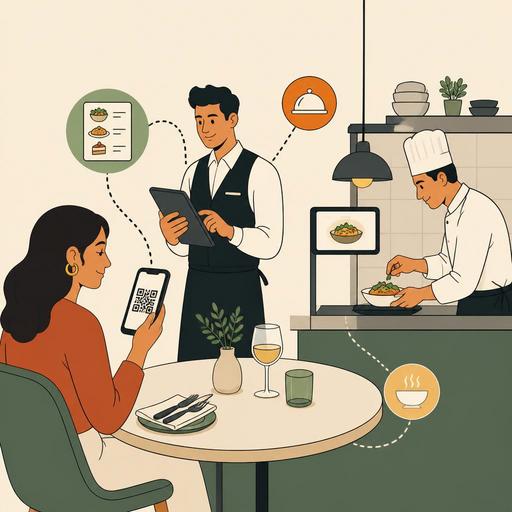
6 Tactics to Shorten Order-Taking Time in Restaurants
Shortening order-taking time in restaurants does not just mean serving the table faster; it affects the entire operation, from table turnover speed to the kitchen flow, and from staff workload to guest satisfaction. Especially during peak hours, even a few minutes of delay causes orders to drop to the kitchen late, the service sequence to break down, and the team to experience unnecessary stress. In this article, we will examine in depth six operational tactics that can be applied in the field. The aim is not to give theoretical advice; it is to build a system that restaurant owners and managers can apply directly.
1. Simplify the order flow at the process level, not at the table
Many businesses assess order-taking time through server performance. Yet the problem is often not the staff but the complexity of the order flow. If the menu is overcrowded, the variations are unclear, or the campaigns do not look clear, the server is forced to explain more in order to take the order. This in turn lengthens the time spent at the table.
For example, in burger-, pizza-, or breakfast-focused businesses, the following kinds of ambiguities are common: are add-ons included, how is the side selection made, is the beverage included in the menu, are the sauces extra? Each of these questions adds an extra burden to the order time.
For this reason, the first step is to organize the menu in a way that makes decision-making easier:
- Divide main products into clear categories.
- Make options limited and understandable.
- Pre-define combinations.
- State frequently asked details in the product description.
Businesses that use a QR menu gain an important advantage here. That is because the details that create confusion in a printed menu can be shown with an organized flow in a digital menu. When the guest sees the options clearly even before the server reaches the table, the ordering process naturally speeds up.
2. Create separate order scenarios for the busiest hours
Lunch service and dinner service are not the same. While the weekday office customer decides quickly, weekend family tables may ask more questions. Despite this, many restaurants apply a single uniform service approach all day. As a result, the team explains more than necessary during peak hours, and orders begin to pile up.
For a more efficient model, create demand-based order scenarios. For example:
- Lunch rush: Highlight products that can be served quickly.
- Evening service: Suggest sharing plates and beverage pairings in advance.
- Takeaway rush: Manage dine-in and delivery orders in separate flows.
Let's give a concrete example: at a restaurant near offices during lunch, instead of the server presenting lengthy suggestions, recommending two or three clear lunch menus significantly reduces order-taking time. The same logic works in coffee chains; frequently preferred pairs such as "medium latte + croissant" shorten decision time.
This is where digital order-management tools come in. Highlighting frequently ordered product groups, making campaign sets visible, and updating the menu flow according to peak hours reduce the team's verbal-explanation workload.
3. Rely on a standard order-collection structure, not the server's memory
One of the biggest problems that lengthen order time is that the order is taken differently by different staff. One server asks for beverages first, another takes the main course first, and yet another leaves extra requests for last. This disorder both lengthens the time and increases the error risk.
For a faster and more consistent system, set a standard order sequence. A simple but effective structure could be as follows:
- Clarify the number of people and the service type
- Take the beverage order
- Complete the main-product selection
- Confirm the extras and the items to be removed
- Repeat the order with a short summary
This structure especially eases the onboarding of new staff. It also takes order-taking time out of being dependent on the individual and turns it into a business standard. If orders are conveyed to the kitchen digitally from a mobile device or at the table, time-wasting steps such as rewriting or entering into the POS afterward are also eliminated.
Critical point: Speed does not mean haste. A server taking the order quickly but misunderstanding it lengthens the total time, because it will require correction in the kitchen. The right standard builds speed and accuracy together.
4. Identify the areas on the menu that create decision fatigue
Some products, even if they have high sales potential, unnecessarily lengthen order time. The reason is not that the product is bad but that it makes deciding difficult. Too many add-ons, vague naming, or small differences between similar products leave the guest indecisive.
For example, on a coffee menu, beverage names that closely resemble one another, or on a burger menu, a large number of options that differ only by sauce, require extra explanation during ordering. The same situation is also common in spread-style breakfasts, bowls, pasta, and pizza categories.
To solve this problem, ask the following questions:
- For which products does the server explain the most?
- In which categories does the guest take the longest to decide?
- Which options are most often confused during ordering?
- For which products does the question "how can we get this?" come up frequently?
After making this observation, you can simplify product names, reduce options, or add prompts that make deciding easier. Businesses with a digital menu infrastructure test these adjustments much faster. For example, updating a description in a category and collecting feedback from the service team for a few days is far more practical than changing a printed menu.
5. Make the delay between the dining room, the kitchen, and the register visible
An order being taken late and being processed late are often confused. Yet the order may have been taken quickly at the table; but if entering it into the POS, dropping it to the kitchen, or progressing in sync with the register is delayed, the total experience still feels slow. The guest remembers not technically how long it took them to place the order, but how quickly their order progressed.
For this reason, businesses that want to improve order-taking time should not focus only on the service staff but should examine three points together:
- Dining room: the moment the order is first taken
- System: the moment the order is processed onto the screen or POS
- Kitchen: the moment production begins
If there is a disconnect among these three steps, no matter how fast the server is, no result is achieved. Especially in large teams, taking notes on paper and then entering them into the system creates an unnecessary intermediate stage. The order dropping directly into the digital flow both shortens the time and reduces problems such as illegible notes, missing products, or forgotten extra requests.
Restaurant digitalization here is not just a technological investment but a tool for establishing an operational standard. Order management, the QR menu, and POS integration working together narrows the gap between the moment of ordering and the start of production.
6. Train staff as a team that "manages the flow," not one that "takes orders fast"
The service team is not just people who write down orders; they are the main element that manages the guest's decision process, maintains the kitchen's pace, and balances the table flow. For this reason, memorizing products is not enough in training. Staff need to learn the micro-behaviors that affect order-taking time.
For example, a well-trained server:
- Knows the campaign before going to the table.
- Recognizes the fastest-coming products.
- Knows which products not to suggest when the kitchen is busy.
- Offers two clear options to an indecisive guest.
- Catches errors at the moment of ordering by summarizing the order.
Short pre-shift briefings are very effective here. The day's sold-out products, the menus to highlight, the peak-hour plan, and the kitchen capacity can be shared with the team in a few minutes. This way the service staff act with a ready framework instead of rethinking at every table.
Also, instead of just saying "be faster," managers should ask the following question: What are the recurring obstacles the team faces while taking orders? Real improvement comes not from blaming people but from reducing the friction in the flow.
Conclusion: Fast ordering is the result of a well-designed operation
Shortening order-taking time in restaurants is not solved by a single staff member moving faster. The real difference emerges when menu clarity, peak-hour scenarios, a standard order sequence, a structure that reduces decision fatigue, integration between systems, and the right staff training all work together. The best result is a system that speeds up ordering without raising the error rate.
Start with a small suggestion: this week, together with your service team, write down the three points that waste the most time at the moment of ordering. Then try to solve one of them through the digital menu, one through staff standards, and one through the system flow. Operational improvement often comes not from big projects but from clear adjustments that start from the right place.
Restomas offers, in a simple structure, the digital tools that help restaurants make their order flow more organized, visible, and manageable.