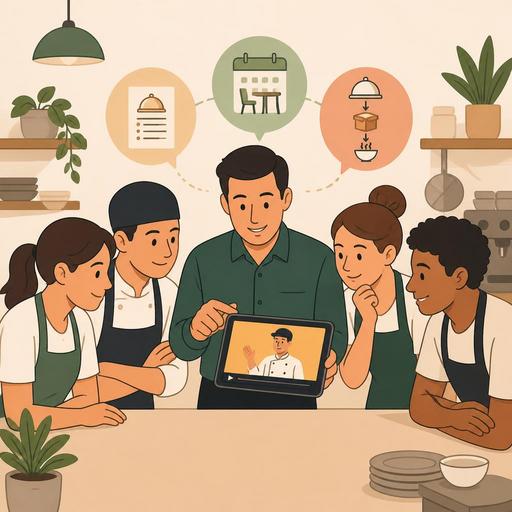
Staff Training Through Video in Restaurants: 5 Clear Benefits
Staff training through video in restaurants has become a practical solution, especially for businesses operating under shift congestion, high staff turnover, and the pressure to deliver standardized service. Having a new server learn the service flow, the bar team learn the recipe standard, or kitchen staff learn the hygiene procedure through verbal explanation alone is often not enough. When the same information is conveyed by different people across different shifts, the standard breaks down. Video content, on the other hand, makes training repeatable, measurable, and more aligned with operations.
This approach does not mean simply "shooting a training video." The real point is turning the business's critical processes into short, clear, and actionable content. Many topics, from product presentation on the menu to takeaway-order preparation, from QR menu updates to the language used to greet reservations, can be taught more clearly with video. Moreover, when designed correctly, this system reduces the manager's burden of explaining the same thing over and over and creates a shared service language within the team.
1. Video training ties restaurant standards to the system, not to the individual
In many restaurants, knowledge resides in the memory of the most experienced employee. But when that person is on leave, leaves the job, or can't pass on the details when things get busy, quality fluctuates. Video training reduces this problem because it takes processes out of personal interpretation and standardizes them.
For example, in a cafe, a new service staff member could be taught "how to approach the table," "the product-recommendation language," and "order re-confirmation" in a different style by each shift supervisor. When these three steps are clarified with short videos, the team moves within the same framework. Similarly, a 60-to-90-second video shot for the "final check of takeaway orders" in the kitchen can help reduce missing sauces, wrong items, or lidding errors.
- Provides standardized explanation.
- Because it can be rewatched, forgotten steps are easily recalled.
- Makes it easier to establish consistency across locations.
- Reduces dependence on the manager.
This structure is even more valuable, especially in businesses with more than one location. Because the same latte presentation, the same greeting line, or the same cleaning routine must be applied similarly at every point.
2. It speeds up onboarding and makes in-shift learning easier
The biggest problem new staff face in their first days is having to absorb too much information in a short time. Memorizing the menu, table numbers, POS usage, allergen information, campaigns, packaging layout, closing tasks, and so on, the employee becomes mentally overloaded. Video content breaks this load into pieces.
Instead of a long onboarding talk, a micro-learning logic is more effective. For example:
- Day one: greeting, dining-room flow, basic menu logic
- Day two: the POS screen, order entry, the cancellation-modification process
- Day three: the peak-hour procedure, handling customer objections, the closing check
Thanks to this structure, the employee learns each topic close to the moment they need it. This is much more important in businesses that use restaurant technologies. For example, in a business that uses a QR menu, the staff need to know how to share the digital menu link, how to explain menu content when customers ask, and how to keep track of items updated in the system. When these topics are explained with video, they are grasped faster than through written procedures.
It is also advantageous from the manager's perspective. Instead of giving the same training from scratch for every new employee, they move the basic training to video; they then use the face-to-face time for Q&A and on-the-floor coaching.
3. It lowers the cost of errors and makes the customer experience more predictable
Training gaps that seem small in a restaurant can create a big impact on the customer side. Situations such as wrong product presentation, giving incomplete information, skipping an allergen warning, a delay in greeting reservations, or an error in a delivery package most often arise from a lack of knowledge. Video training, because it explains critical moments visually in particular, can be more effective in these areas.
Let's consider a concrete example: in a brunch business, the topic of "how are egg doneness levels confirmed?" can get muddled in verbal explanation. But when both the phrasing to use with the customer and the way to relay it to the kitchen are shown in a short video, the margin for error drops. Similarly, sensitive topics such as "how is cross-contact prevented when a gluten-free request comes in?" settle in more clearly with visual explanation.
What matters here is not leaving the videos theoretical. Every video should be based on a real operational scene. In other words:
- Filming should be done at the actual counter,
- The business's own equipment should be used,
- The error points that genuinely occur in the business should be addressed,
- At the end of each video, a clear "correct practice" should be shown.
This way, the training content moves beyond generic advice and turns directly into the business's standard.
4. How do you produce a good training video? A practical structure for restaurants
A professional studio is not required for a quality training video. What restaurants really need is a clear script and the right scope. Because many businesses shoot videos that are too long, the content goes unwatched. Yet the effective format should be simpler.
Which topics should be turned into video?
Give priority to the most frequently recurring and most error-prone processes:
- The opening-closing routine
- The hygiene and handwashing procedure
- Order-taking and confirmation language
- Takeaway-order preparation
- The refund, complaint, and compensation process
- Using the POS or order management screen
- The QR menu, campaign, and product-update flow
5 basic rules for video production
- Cover one topic per video. Instead of broad titles like "service training," choose a narrow topic like "the first approach to the table."
- Aim for the 2-to-4-minute band. Content short enough to watch between shifts is more functional.
- Use real employees and real spaces. This makes it easier to transfer to practice.
- Add screen recordings. If the POS, reservations, or order management is being explained, don't just talk; show the steps.
- End with a checklist. The viewer should clearly know what to do after the video.
For example, in a video prepared for reservation management, the greeting line, table direction, the phrasing to use if a wait forms, and the step for updating the reservation status on the system screen can be shown one after another. If the business manages its digital reservations, menu, or order flow from a single center, relating the training content to these digital flows provides great convenience. This way, the staff learn not only "what to do" but also which tool to do it through.
5. Building a video library is not a one-time project but a living system
The most common mistake is shooting a few videos and closing the matter. Yet the menu changes, a campaign comes along, the service language is updated, new equipment is added, the packaging standard is revised. For this reason, the video training library should be treated as a living structure.
For a practical system, you can divide the content into categories:
- Onboarding videos: the basic content everyone starting out will watch
- Role-based videos: server, cashier, barista, busser, kitchen staff
- Process videos: opening, closing, peak hours, delivery, cleaning
- Update videos: a new menu, a campaign, a system change
At this point, it is useful to consider the content together with operational data. On which items do more refunds come in? On which shift do order errors increase? Which service problem comes up most often in customer reviews? The answers to these questions can determine the topic of the next training video. In other words, training production should not be disconnected from the floor; it should be tied to the operation's real needs.
The best approach for a manager is this: every recurring error is a potential video topic. Every frequently asked question is a potential micro-training. Every new system feature should be supported with a short screen explanation. A structure built this way preserves the business's memory even as staff change.
As a result, staff training through video content is one of the effective ways to not only convey information but also preserve standards in restaurants. When designed correctly, it speeds up onboarding, makes error points visible, makes the use of digital tools easier, and makes the customer experience more consistent. If you want to make your restaurant operations more orderly together with digital processes, the structure Restomas offers can help you think of these flows in a single center.
