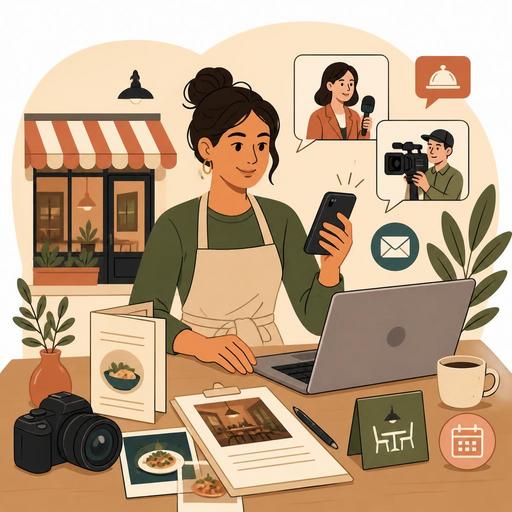
A Guide to Getting Restaurants into Local Media: A Press Release Template
Getting into local media with a press release is still an effective method, especially for restaurants that want to grow their recognition in their neighborhood, district, or city. However, many businesses think a press release is only an announcement of a new branch opening, and as a result they either fail to create news value or the text they send goes straight to the trash. Yet a properly crafted press release can turn a restaurant's story, its distinguishing feature, and its current development into a usable news item for local newspapers, news sites, city guides, and niche publications.
In this guide we'll address an approach that genuinely works for restaurant owners: which developments become news, how to write a release, who to send it to, how to follow up, and how to support this process with digital operations. The goal is not just to "get into the press"; it's to deliberately build the visibility that gets the right customer to notice you.
Which developments genuinely carry news value for restaurants?
From the perspective of local media, the most important question is this: "Why should this information interest the reader?" Everything that's important in a restaurant's own eyes is not news to a journalist. A topic with news value is one that has community impact, offers a new angle, fits a current context, or creates a concrete change.
For example, simply saying "our menu has been renewed" can fall flat. But the phrase "we've moved to a seasonal menu with a new supply model built with local producers" is stronger. Because here sustainability, the local economy, and a gastronomy trend come together.
- A new concept or repositioning: A breakfast-focused venue moving to evening service, launching a vegan product line, or offering an open-kitchen experience.
- A social or local connection: Collaboration with producers in the area, a solidarity menu for disaster victims, an internship program for gastronomy students.
- Special event series: Chef meetups, tasting evenings, local-product-themed weeks, Sunday brunch events for families with children.
- Technological or operational transformation: Switching to a QR menu, digitizing the reservation flow, new systems that improve the waiting experience during busy hours.
- An award, achievement, or milestone: A particular anniversary, a new branch opening, an important partnership, or a notable gastronomic project.
The critical point here is this: frame the development not from your own internal perspective but through the angle that touches the reader's life. Local media wants a news feed, not advertising copy.
How to write an effective press release?
A good press release is clear, not ornate. It makes the editor's job easier; it reveals the subject in the headline, gives the summary in the first paragraph, and offers context and detail thereafter. Restaurants most often make this mistake here: overdoing brand praise and losing the news tone.
The basic structure of a press release
- A strong headline: The news element must be clear. For example, "X Restaurant in Kadikoy Enters a Seasonal Menu Era with Local Producers."
- The lead paragraph: Who, did what, where, why is it important? Answer these four questions in the first section.
- The detail section: The background of the development, what it means for the customer, and the event date or implementation method if any.
- A quote: A short, natural, and insightful statement from the business owner or chef.
- Closing information: Contact person, phone, email, image link, and reservation or event details if applicable.
An actionable mini template
Headline: [City/Region] + [Restaurant Name] + [development carrying news value]
Lead: [Restaurant name] has launched [innovation/development] in the [neighborhood/district] area. The initiative is drawing attention in terms of [target audience or local impact].
Detail: Explain how the new initiative works, what need it answers, and how it is reflected in the menu or experience.
Quote: A sincere, measured statement can be used, such as "We made this change so that our guests can decide more comfortably, especially during busy hours, and experience things more fluidly."
Closing: The event date, trial period, image access, and media contact information are added.
Tip: Don't write the release like the "about us" text on your website. Keep it plain enough for a journalist to copy and work with, but concrete enough to interest the reader.
Critical mistakes made when distributing to local media
Failed press efforts often stem not from a bad idea but from bad distribution. Mass-emailing the same text to dozens of people, leaving the subject line vague, or not attaching an image can make you invisible on the editor's side.
- Wrong targeting: Sending to outlets that aren't interested in gastronomy or don't speak to your local area.
- Advertising language: Using subjective and overly marketing-heavy phrases like "the city's best restaurant" or "a unique feast of flavor."
- A weak subject line: Using generic titles that don't explain why the email should be opened.
- An incomplete media kit: Not sharing high-resolution images, a short introductory note, and contact information.
- No follow-up: Not sending a short and respectful reminder after the send.
Let's give a concrete example: a cafe announcing a new brunch menu may not get far if its email contains only a PDF menu. But if that same email includes a short release, two horizontal venue photos, a plate image, the event date, and how the reservation flow will work, it becomes easy for the editor to use.
The restaurant's digital infrastructure also supports visibility here. Suppose your news was published and a curious user looked your business up. If the reservation process is confusing, the menu isn't up to date, or busy-hour information isn't clear, media visibility doesn't convert. For this reason, you need to think about press work together with the digital customer journey.
A plan for converting interest into customers after the press release
Appearing in local media is the beginning of the work. The real value emerges when this visibility returns to the business as measurable interest. Restaurants often use the opportunity only halfway because they make no preparation after the news runs.
A pre-publication preparation checklist
- Update the menu: The product, event, or promotion mentioned in the news should appear clearly on the digital menu.
- Simplify the reservation flow: Especially if an event story is running, the user should be able to book a table quickly.
- Align your Google Business Profile and social media bio: Don't let your digital storefront contradict the message in the news.
- Brief the host team: Staff should be able to answer questions coming from the news with the same clarity.
- Create tracking links: Observe which news item brought how much traffic or reservation interest.
For example, if your "chef tasting evening" news ran in the local paper, it's wiser to make the event detail, the time window, and the limited-capacity information visible within the digital menu rather than forcing the user to get lengthy information over the phone. Similarly, when reservation or order management is clarified with digital tools, media interest can be managed without turning into operational chaos.
The reality restaurants often overlook here is this: PR doesn't work alone; it produces results when operations, communication, and the digital experience work together.
A local media action plan restaurants can apply in 30 minutes
If you want to take action right after reading this article, you can start with the short plan below.
- Choose a single news topic: An opening, a new menu, a local-producer collaboration, an event series, or digital transformation.
- Write the news value in one sentence: Answer the question "Why is this important for the local reader?"
- Prepare a short release of 150-250 words: Clear out unnecessary adjectives.
- Choose 3 strong images: One shot each of the venue, a product, and the team is enough.
- Draw up a target media list of 10: Local newspaper, district news site, city living platform, gastronomy-focused publications.
- Send personalized emails: Add a short note for each outlet.
- Follow up politely after 48 hours: Ask for a brief reply, such as "I'd be happy to share more information if you're interested."
This approach turns scattered PR efforts into an organized system. What's more, a well-crafted news flow also supports your social media content, your Google visibility, and customer trust.
To be visible in local media, you don't need huge budgets; you need a topic with high news value, a well-written release, and a ready digital customer experience. If you want to keep your menu, reservation, and order flow organized while increasing your restaurant's visibility, the digital tools Restomas offers can help make this process more consistent.
