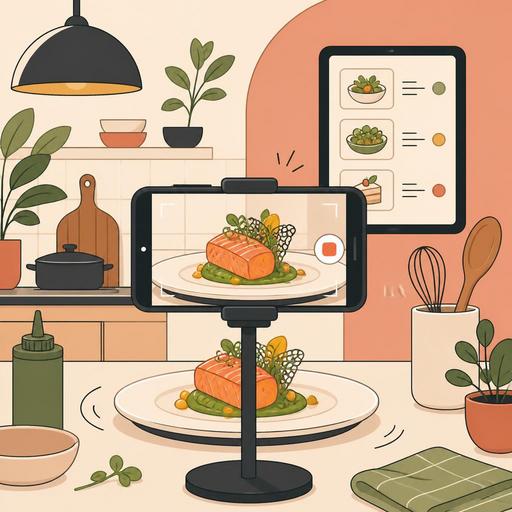
7 Common Traits of Viral Food Videos on TikTok for Restaurants
Viral food videos on TikTok are not just about good-looking plates. For restaurants, the real matter is being able to turn a video that gets views into orders, reservations, and brand recall. When you look closely at the food content that succeeds today, some recurring structural traits stand out: creating curiosity in the first second, focusing on a single clear idea, choosing products that work well on camera, and making the customer's next step after the video easy. In this article, we'll cover the 7 common traits of standout food videos on TikTok through concrete actions for restaurant owners, chefs, and business managers.
1. They deliver a strong visual trigger in the first 2-3 seconds
In the TikTok feed, the user doesn't stop; the video stops them. That's why, in food videos with viral potential, the opening scene is almost always strong. Visuals such as cheese stretching as it melts, a crispy item breaking in two, sauce being poured at the last moment, or a service moment accompanied by smoke or steam keep the viewer in the video.
The common mistake restaurants make here is starting the video with the venue's exterior, long logo animations, or empty-table shots. Yet on TikTok, the product speaks first and the brand comes later. For example, if you sell burgers, the first frame of the video shouldn't be the bun, but the texture the knife creates as it cuts the patty. If you offer breakfast, instead of the whole spread, honey flowing onto clotted cream may be more effective.
Action: Identify 5 items on the menu that are "strong on camera." Let these be products that melt, break, pour, show layers, or release steam. Featuring these items on your QR menu and bringing your menu structure onto the same line as your social media content prevents a disconnect between the content and the ordering experience.
2. They convey a single message in a single video
An important trait of viral food videos is that they don't try to say many things at once. When a single video tells about the venue tour, kitchen hygiene, a campaign, a new menu, and the chef's story all at once, the viewer loses track of what to focus on. Strong videos, by contrast, are built around a single promise.
This promise can be reduced to clear sentences like the following:
- "How is the city's most molten chocolate soufflé served?"
- "Why is this noodle tossed in the wok at the last moment?"
- "What's the reason you eat this sandwich layer by layer, not in a single bite?"
The viewer should understand what the video is about in the first few seconds. Especially on restaurant accounts, this clarity also makes content production easier. When making a weekly plan, assigning a single main idea to each video provides a more organized production flow among the kitchen, service, and social media teams.
Action: Divide your content calendar into categories such as "product," "preparation technique," "service moment," "customer reaction," and "limited-time menu." Choose a single category for each video. This way, content production becomes aligned with operations rather than random.
3. They use a structure that leaves the viewer's curiosity open
One of the most fundamental elements that increases views on TikTok is curiosity. Successful food videos, even though they show the result right away, don't consume the entire process at once. The viewer thinks "what will happen in the end?", "what will come out of it?", "which sauce will be added?" For this reason, the videos most often proceed step by step.
For example, if you're showing the preparation of a croissant, showing the final product in the first frame is not a problem; but afterward, the opening of the layers, the addition of the filling, and the final cross-section shot should come in sequence. In a steak video, too, instead of showing only the cooked meat, the searing sound, the final touch with butter, and the cross-section image should be presented as a chain.
The important point here is to produce content without straining the kitchen operation. Trying to film every service moment can create pressure on the team. Instead, creating a standard shooting flow for a few signature items that can be reproduced during non-busy hours is more sustainable.
- Show a strong product detail in the first frame.
- Add 2-3 short steps from the preparation process.
- Give the final presentation a close-up.
- End the video with a clear closing that sparks a desire to order or visit.
4. They feature visually "shareable" products
Not every tasty product goes viral; nor is every viral product the best-selling item on the menu. The products that stand out for TikTok generally contain visual motion. Layered desserts, plates with pour-over sauces, flambéed presentations, large-portion comparisons, high-color-contrast drinks, and dishes whose preparation moment is dramatic are advantageous for this reason.
This doesn't mean you have to recreate your menu from scratch just for social media. But you do need to establish a link between choosing camera-friendly products and menu engineering. For example, if you have a much-loved item that looks flat on camera, you can rethink the serving dish, the final touch, or the cross-section presentation. You can increase the content value by saucing a dessert at the table, serving a drink in two stages, or serving a main dish with a focus on the cross-section.
Action: Evaluate the items on your menu with these three questions:
- Is there an eye-catching moment during the preparation stage?
- Does it look strong in close-up during service?
- Would the person watching the video want to come to the venue to try it?
This evaluation can also affect your digital menu ordering. Keeping the items that attract interest on social media visible on the QR menu lets the customer quickly meet the product they saw in the video on the order screen.
5. They don't neglect the human element
Even though the food is in focus, most viral videos have a human touch. The chef's final touch, the barista's pouring technique, the service staff carrying the plate, the customer's reaction at the first bite, or a quick hand movement in the kitchen makes the video more alive. Because TikTok shows not only the product, but also the process and the character.
Restaurant owners sometimes think it's enough to show only the plate in the content. Yet a human impact can be established even without showing a face. A gloved hand making the final garnish, the kitchen team working in sync, or even the order flow moving quickly at the register conveys a sense of trust and rhythm.
What needs attention here is that the content shouldn't disrupt operations. Instead of staff acting out a role, short and natural snippets of the real workflow are more effective. On the customer-experience side, too, it's important that the person who comes to the venue can easily find the product that attracted interest on social media. Otherwise, the content creates an expectation that the experience doesn't meet.
6. They don't copy trends; they adapt them to their own format
TikTok trends are an opportunity for restaurants; however, exact copying most often looks superficial. Successful accounts, when they see a trending sound, structure, or format, reinterpret it in their own brand language. For example, a popular "before-after" structure can be adapted for a restaurant as a raw product turning into a finished plate. A fast-cut trend can be used to show the prep tempo for lunch service.
What matters is that the trend fits the restaurant's reality. A fine-dining venue using an overly chaotic, humor-focused trend can damage its brand perception. By contrast, an energetic café can take ownership of trends more comfortably with fast service and fun customer interaction.
Action: Use the following filter for every trend: "Does this format fit our kitchen flow, our target audience, and our menu structure?" If it doesn't, it's better to just be a viewer. If it does, use the same trend by tying it to the dish of the day, the new-season menu, or kitchen preparation.
7. They tie viral visibility to a measurable experience
This is the most critical point: a viral video on its own is not a business result. What's valuable for the restaurant is the step the customer takes after the video. Did they visit the profile, look at the menu, consider a reservation, ask about a specific item at the venue? For this reason, a clear bridge needs to be built between the content and the digital touchpoints.
For example, if the product featured in the video appears under a different name on the menu, the customer gets confused. If a limited-time product seen on social media isn't up to date on the QR menu, a loss of trust occurs. Similarly, if the staff don't know about the product featured in the video, social media interest doesn't turn into a sales opportunity.
That's why a TikTok strategy is the concern not only of the content team, but also of menu management and the service operation. The products featured on social media need to be visible on the digital menu, out-of-stock products need to be updated quickly, and campaign or new-product information needs to be known by the whole team. Digital tools like Restomas can help reduce the disconnect between content and operations at this point.
In conclusion, the formula for viral food videos on TikTok is not "luck." A strong first frame, a single message, a curiosity-focused structure, a shareable product choice, the human element, smart trend adaptation, and a measurable experience connection all work together. The most accurate start for your restaurant is not producing content every day, but choosing a few signature items that work well on camera and presenting them within a system that is consistent across the menu, service, and the digital experience.
Restomas can help you make the products that attract interest on social media more consistent with your digital menu and operations flow.
