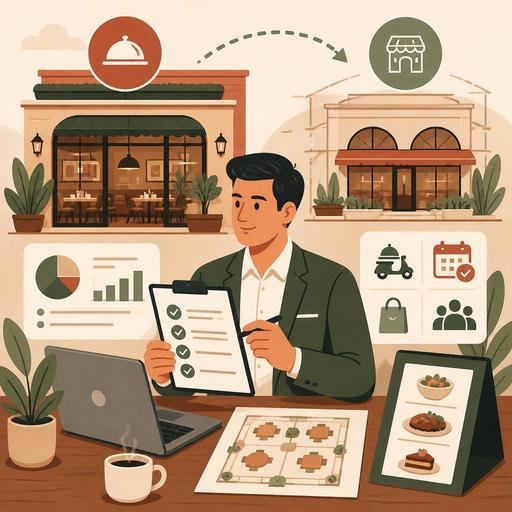
10 Questions to Ask Before Opening a Second Restaurant Location
The questions to ask before opening a second restaurant location are the most practical way to balance the excitement of growth with a realistic plan. Things may be going well at the first location; the dining room fills up, takeaway is growing, and you may have built a base of regulars. However, opening a second site doesn't mean an exact copy of your current success. A new location means a new rent structure, a new team, a different customer profile, a changed service pace, and a more complex operation. For this reason, the decision should be made not just on the feeling that “there's demand,” but with measurable preparation.
While many business owners see the second location as an opportunity, the truly critical issue is building controlled growth. Because the small hiccups tolerated at a single location can directly affect profitability and brand perception at a second site. The 10 questions below offer a practical framework for putting the second-location decision on firmer ground.
1) Is the first location really a scalable model?
Your first location may be busy; but busyness alone doesn't mean scalability. First, you need to clarify this distinction: Is the success specific to the location, or is it tied to your system? For example, very strong foot traffic on the street, neighborhood loyalty built over years, or the owner being personally present on the floor may be pushing performance up artificially.
Ask yourself these questions:
- How much of the sales depends on the owner's individual oversight?
- Is the kitchen flow based on a written standard, or on the chef's memory?
- Are menu costs and portions consistent?
- Does service quality during peak hours vary from person to person?
If the operational processes aren't standardized, a second location magnifies existing problems. At this point, a digital order flow, centralized menu management, and item-level update discipline provide a serious advantage in understanding whether the model can be replicated.
2) Why is the new location opening: for demand, or for ego?
This question may sound harsh; but it's necessary. Some businesses open a second location for brand visibility, some want to enter an area before a competitor, and some see the success of the first location as the natural next step. Yet if the right reason isn't clear, you end up making an expensive experiment in the wrong location.
Healthy justifications can be these:
- Reaching the capacity limit in the current area
- The takeaway range failing to meet demand
- A similar customer profile being verified in another area
- The business model becoming replicable in terms of shifts, menu, and staff
For example, it may be getting hard to find a table at your first location during lunch. In this case, a second location may seem sensible. But if the real problem isn't table capacity but slow table turnover, then improving reservation management, table planning, or the service flow may be a better investment than opening a new location.
3) Is the location choice based on customer behavior, or only on rent?
One of the most common mistakes at the second location is confusing “affordable rent” with “the right location.” Low rent can be attractive; but if your target audience isn't in that area at the right hours, the advantage quickly turns into a disadvantage.
In evaluating a location, you need to consider not just real estate but operations too:
- Is the lunch and dinner customer profile the same, or different?
- Is the area distribution efficient for takeaway?
- Is it a stretch with high foot traffic but low purchase intent?
- Do competitors in the area sell on price, experience, or speed?
- Is the new location consistent with your existing brand perception?
For example, if your first location works with fast lunch service in an office-heavy district, opening a second location with the same menu and the same service style in a family-oriented neighborhood may not produce the expected result. For this reason, the location decision must be handled together with the menu, pricing, service pace, and channel structure.
4) Is the menu simple and manageable enough for a second location?
A broad menu sometimes looks like an advantage at the first location; but at the second location it creates complexity. More products mean more supply risk, more training needs, and a higher chance of error. For this reason, before the second location you need to run the menu through a “growth filter.”
Separate the following products:
- Products in high demand that don't strain the operation
- Products that are a brand signature but have long preparation times
- Low-selling products that create a stock and labor burden
- Products that perform well in takeaway
A concrete example: special dishes that perform strongly with the chef's touch at the first location may not come out at the same quality at the second. By contrast, products with standardized preparation, a clear recipe, and a repeatable presentation provide safer growth. A QR menu and a centralized menu-update infrastructure also make it easier to maintain consistency in price, contents, and availability between the two locations.
5) Can your supply and stock discipline handle two sites?
Stock gaps that go unnoticed at a single location can turn into a serious cost leak at a second location. Because as product movement increases, so do waste, wrong orders, missing shipments, and weaknesses in control. Before the second location, this matter must be clarified: Will purchasing be centralized, or will the branches place their own orders?
Both models have advantages; but what matters is providing visibility. Questions like which product turns over faster at which location, which item runs out frequently, and which product is on the menu but out of stock can't be kept scattered. POS integration and sales-data alignment here are not just a technology choice, but a tool of operational security.
6) Does the team structure function without the owner's physical presence?
The most critical test of the second location is the staff. If at the first location the team works more disciplined when they see you, problems are solved by your intervention, and training is passed on verbally, then maintaining the same quality at the second site becomes difficult. For this reason, the second location is first a question of the organizational chart.
The following roles must be clear:
- Who will maintain the standard between locations?
- Who will be responsible for training new staff?
- How will shift handovers be recorded?
- Through what flow will customer complaints be resolved?
For example, sending an experienced floor manager to the new location may be sensible; but in that case, you also need to plan for the gap that opens at the first location. Otherwise, while the second location is opening, the first one's performance drops. In the growth decision, you should ask not just “whom can we send?” but “who keeps both locations standing at the same time?”
7) Has financial resilience been calculated beyond the opening cost?
The second-location budget is often discussed in terms of décor, equipment, and deposits. Yet the real issue is the cash pressure after opening. A new location may not run at full efficiency from day one. The training process, shifts that haven't settled, the need for promotion, and start-up waste can take longer than expected.
For this reason, the following items must be considered separately:
- Pre-opening investment expenses
- The possibility of low efficiency in the first months
- The simultaneous staffing burden of two locations
- The supply-payment balance and cash-flow pressure
The goal here isn't to be fearful, but to build a buffer. If the first location's cash flow is too fragile to carry the learning period of the second on its own, the timing of growth can be reconsidered.
8) Will the brand experience feel the same at both locations?
When the customer walks into the second location, they should feel the same brand; but this doesn't mean copying everything exactly. The music level, the welcome, the service speed, the plating, the reservation flow, and the digital touchpoints all form a whole. Inconsistency creates quick disappointment, especially among loyal customers.
For example, if the QR menu is fast, clear, and current at one location but incomplete or outdated at another, the customer interprets this directly as brand quality. Likewise, if reservation confirmations are done regularly at one location but handled haphazardly at another, the problem isn't just operational — it's an experience problem.
9) Is your management visibility sufficient?
When the second location opens, intuitive management falls short. Instead of an end-of-day feeling that “today wasn't bad,” you need to see which location had a bottleneck at which hour, which products stood out, and where delays occurred in the service flow. Otherwise, decisions are made on personal impressions.
Digital reporting, order management, and a comparable data structure across locations are not a luxury at this stage but a necessity. Because with the second location, the business is no longer a single-site restaurant; it becomes a small-scale but multi-site system.
10) If you had to open today, which three risks would challenge you most?
The final question is a stress test. Honestly write down three main risks for yourself. For example: staff turnover, menu complexity, and cash pressure. Then draw up a preventive plan for each. If you can't name the risks, your preparation probably isn't concrete enough yet.
As a practical approach, you can use the following checklist before opening:
- Put your standard operating steps in writing.
- Simplify the menu with a second-location logic.
- Centralize price and content management across locations.
- Monitor reservation, order, and sales data in a single flow.
- Create a training and audit calendar for the first 90 days.
A second location, when planned correctly, is a strong step in growth; when planned poorly, it can drain the energy of the first. For this reason, base your decision not just on excitement, but on how visible and manageable you've made your processes.
Restomas can help you put growth decisions on firmer ground by making restaurant operations — from the menu to the order flow and reservation system — more visible.
