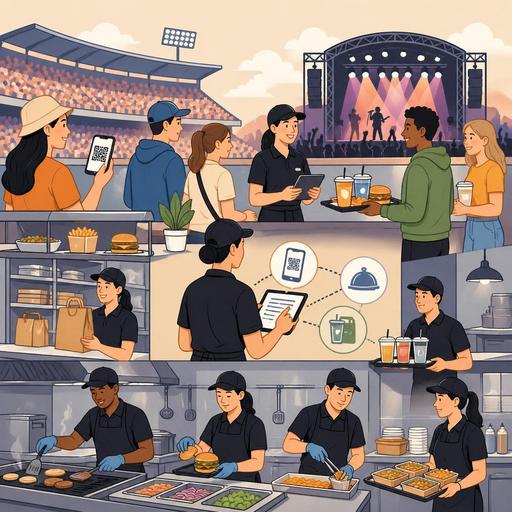
A Peak-Hour Order Plan for Stadium and Concert Venue Restaurants
Peak-hour order management in stadium and concert venue restaurants requires a far different discipline from classic restaurant operations. Demand arrives in waves, guests have a short decision window, product expectations are clear, and tolerance for delay is low. In a few critical time slots, such as just before a match, during halftime, when concert doors open, or before the main act, hundreds of orders can hit the kitchen and register at the same time. For this reason, success comes not only from a fast team but from the right menu structure, a smart order flow, a clear division of roles, and digital visibility.
In these venues, the problem is often not "too many customers coming" but orders piling up on the wrong channel at the wrong moment. On one side, the queue at the register grows, while on the other, the kitchen may be working the same product over and over on different tickets. Some tables expect fast service, while a customer eating while standing wants to get their product within just a few minutes. Therefore, peak-hour management is not speed alone; it is a matter of channel balancing, product standardization, and real-time decision-making.
You cannot gain speed without understanding the demand wave
In stadium and concert restaurants, the order flow does not spread evenly across the day. Sharp surges form in specific minutes. For example, before a match, beverage- and snack-heavy orders come to the fore, while during halftime even the easiest-to-prepare products can become critical within minutes. At a concert, fast-consumption products pick up as the doors open; density occurs again as the main act approaches; and after the performance begins, the order pace may drop somewhat.
This structure requires the business to look not only at total daily revenue but at 15-minute density windows. The answers to questions such as which product sells most at which moment, at which station a bottleneck forms, and where the longest delay occurs between the register and the kitchen determine the operations plan.
Let's consider a concrete example: a sales point under the stands sells burgers, fries, beer, and soft drinks. The problem is often not the burger's cooking time; it is the bottleneck of beverage filling, payment approval, and product handover at the same counter. In this case, speeding up the kitchen is not the sole solution. You need to think of the steps of taking the order, preparing it, and delivering it separately.
- Note at the end of the shift in which minutes order peaks formed.
- Map out the top 5 best-selling products and the preparation steps for these products.
- Track separately whether the queue builds at the register, in the kitchen, or at the handover point.
- Flag the products that cause the most delay on the menu during peak demand.
The peak-hour menu: not selling every product, but moving the right product
In stadiums and concert venues, a broad menu is often not an advantage but a risk. The guest here is not seeking a long gastronomic experience; they want a quick decision, consistent taste, and a short wait. For this reason, separating the peak-hour menu from the regular menu is highly effective. The aim is not to reduce options but to increase order speed and production consistency.
For example, a structure with three different breads, four different sauces, and numerous side items makes kitchen communication difficult during busy moments. By contrast, a few strong, predefined combos both shorten order time and reduce the staff's risk of error. Moving peak-hour products to the top on QR menus or digital order screens also reduces decision-making time.
What to consider when preparing the peak-hour menu
- Feature products with few preparation steps. Products that can be completed at a single station provide an advantage during busy hours.
- Strengthen the combo logic. Pairings of a beverage and a snack shorten decision time.
- Limit customization. Decisions such as "extra sauce," "remove it," or "change the side" slow down the kitchen flow.
- Check stock and production alignment. The raw material for the best-selling product should be at the most accessible point.
Digital menu management offers an important advantage here. Featuring certain products before peak hours begin, instantly hiding a sold-out product, or leaving only the quick-to-prepare options active reduces the staff's verbal-explanation burden. In systems like Restomas, updating the menu from a single center ensures consistency, especially across multiple sales points.
Separating order channels lowers queue pressure
The biggest mistake during peak hours is wanting to push all orders through a single channel. Yet stadiums and concert venues have different customer behaviors: the person who quickly grabs their product and returns to their seat, the group eating while standing, the guest in a box who orders in a more planned way, or the spectator who places another order during a break in the event. Funneling all these segments into the same register flow creates a bottleneck.
A more efficient model is to split order channels by usage scenario. For example, pre-orders can be taken via a QR menu, only fast products can pass through the register, and only beverage handover can be done at certain points. This way, not every order is subjected to the same process.
In a concrete scenario, a guest seated in the box section orders through a QR menu; meanwhile, ready-packaged products in the standing service area can be run from a separate counter. When the kitchen display or order management panel clearly shows which order belongs to which handover point, confusion decreases. Especially in setups with POS integration, gathering register and digital channel data into a single flow makes it easier for the manager to intervene in real time.
- Use the register only for essential transactions.
- Connect orders taken via the QR menu to a separate preparation flow.
- Separate handover points by product type: beverage, hot product, ready package.
- Clarify the cancellation and change procedure before peak hours.
Staff placement and role definition make a difference within minutes
The reason even the most experienced team struggles during peak demand is often not the number of staff but the placement plan. A setup in which one employee must simultaneously take orders, track payments, prepare beverages, and make handovers is not sustainable. During peak hours, tasks should be simplified and staff movement minimized.
In a well-functioning model, roles are clear: one person monitors the order flow, one plates hot products, one manages the beverage area, and one controls handover. The chef or shift supervisor, rather than jumping directly into production, watches the bottleneck and provides direction. Especially in short but high-volume events, the "everyone does every job" approach is less safe than the "everyone runs their own station flawlessly" approach.
For example, in a 15-minute halftime window, rather than having the staff at the register explain the order, having decision-supporting visuals available in the QR menu provides great convenience. Likewise, having the staff at the handover table see a screen of order numbers, product status, and pending items reduces the need for verbal coordination.
A mini checklist before the shift
- Has the mise en place for the best-selling products been completed?
- Does the team know which product comes out of which station?
- Have the items at risk of selling out been entered into the system?
- Has the peak-hour ordering been updated in the QR menu?
- Is the signage ready in the handover area to prevent confusion?
Post-event analysis is the key to managing the next surge
Peak-hour order management is not a one-off setup. Every match, every concert, and even different artist profiles at the same venue can produce different ordering behavior. For this reason, you need to do a short but disciplined review after the event. Questions such as which products sold out faster than expected, on which channel the queue grew, which change was requested most, and at which point the staff struggled improve the operation.
Digital records provide a great advantage here. When order times, product distribution, cancellation points, and channel-based movement can be seen on a single screen, comments move from intuition toward data. The restaurant manager can then adjust the menu order, staff plan, and preparation quantity more realistically for the next event.
In short, success in stadium and concert venue restaurants is not just about providing fast service. What truly makes the difference is anticipating the surge, simplifying the menu, separating order channels, and managing the team with clear roles. When this structure is in place, both queue pressure decreases and the customer experience becomes more fluid.
Restomas can help you manage these intense service moments in a more controlled way by bringing the QR menu, order management, and operational visibility together in a single structure.
