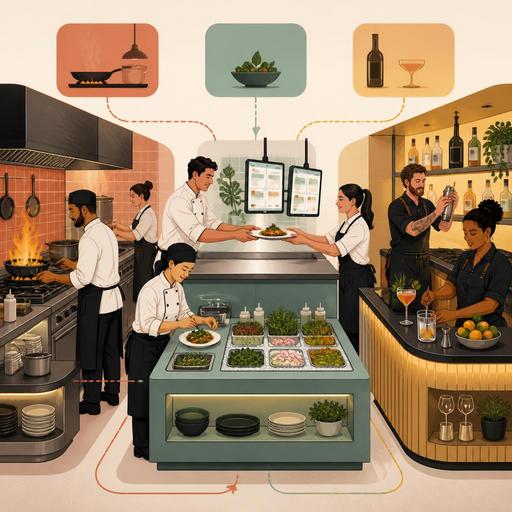
Station-Based Kitchen Flow: Synchronizing Hot, Cold, and Bar
Station-based kitchen management is one of the fundamental factors that determine service quality, especially in restaurants that put out products with different prep times at the same time. When the hot kitchen, cold prep, and bar work disconnected from one another, the problem isn't just a delayed order; you also get products coming out in the wrong sequence, plates that lose quality because they've been waiting, an experience that fragments at the table, and unseen stress within the team. That is why coordinating hot, cold, and bar is not merely a matter of in-kitchen discipline; it is directly a matter of customer experience and operational efficiency.
A well-built station system clarifies what each section will put out, when, and with what priority. The aim is not to make everyone work faster; it is to produce at the right moment, in the right order, using the right information. This structure is critically important especially for à la carte restaurants, busy breakfast venues, businesses that serve cocktails, and restaurants taking orders across multiple channels.
Where does the real problem in station-based kitchen management begin?
In many businesses, the disruption comes not from staff being slow, but from the order flow not being designed according to station logic. Even if the server enters the order completely, while the hot station starts the main dish, the cold station may see the appetizer late, or the bar may have the drinks ready but, not knowing the service priority, the products may sit on the counter.
For example, imagine a table of four with one starter, two main dishes, one salad, and three drinks. If this order lands in the kitchen as a single block but the course sequence, service timing, and station notes aren't separated out, this picture is common:
- The bar prepares the drinks early, and service is delayed.
- The cold station puts out the salad, and the hot kitchen can't keep up with the main dish.
- The main dish is ready right after the starter reaches the table, and the table's pace is thrown off.
- The server tries to manage which product should go out first using real-time memory.
Such problems are often labeled a "lack of communication," but the root cause is usually a lack of standard flow. In other words, even if the team is talking, the system isn't talking.
How is synchronization established among hot, cold, and bar?
The foundation of coordination is seeing the order not as a product list but as a timed production flow. Every station has a different prep time, waiting tolerance, and service dependency. Synchronization can't be achieved without making this difference visible.
1. Classify products by prep time
Separate the products on the menu not only by category but by production rhythm. For example, even if a grilled main dish and a pre-prepped salad appear in the same order, their start moments should differ. On the bar side, too, an espresso-based drink, a bottled drink, and a cocktail don't come out at the same speed.
That is why, for each product, the following three questions should be clear within the team:
- How many minutes of work does its prep require?
- Once it's ready, how long can it wait without losing quality?
- Which product must it be served alongside?
2. Define station triggers
Having every order land at all stations at the same time isn't always right. Some products should be started immediately, while others should be triggered close to service confirmation. For example, if the meat dish at the hot station is to be started only near the completion of the starter service, that rule must be written down. For the bar, too, triggers such as "when the table is seated," "with the main course," or "after dessert" should be clearly defined.
3. Make the pass the decision center
The heart of coordination is the pass. The aim here is not just to collect plates but to manage timing across stations. The chef or shift lead responsible for the pass must know which product can wait and which must go out immediately, and run this not on the fly but with a standard rule.
Digital order screens, station-based routing, and having order notes visible in one place make a serious difference at this point. Especially when the station an order landed at, the change notes, and the service sequence can be read on a single screen, the need for verbal repetition decreases.
How does menu design affect station coordination?
Station-based management isn't only an in-kitchen process; the menu setup can directly make this coordination easier or harder. Products that load high complexity onto three different stations at the same time create a bottleneck during peak hours.
For example, if a single plate has a hot protein, a last-minute cold garnish, and a special pairing drink that comes out of the bar, the product may look appealing in theory but in practice requires three stations to work in flawless synchrony. If the team structure and service volume aren't suited to that, the product's recipe or service setup should be rethought.
At this point, restaurant owners can take the following actions:
- Examine which stations the most-ordered products during peak hours load up.
- Simplify plates that require multiple critical operations at the same time.
- Identify components that can be prepped in advance.
- Create a service-sequence standard for products with high bar-and-kitchen dependency.
This is an advantage for businesses using a QR menu or digital menu infrastructure, because it's possible to quickly update product descriptions, variations, and temporary service rules. For instance, even just highlighting, at certain hours, only the drink pairings that don't overburden operations can ease the flow.
How is station discipline established in staff management?
Even the best flow plan breaks down quickly if the team roles aren't clear. In a station-based system, each staff member needs to understand not only their own task but the rhythm of the other stations as well. This doesn't mean everyone does every job; it means knowing the impact of one's own work on the other sections.
One method that works in practice is short shift briefings. In a 5-minute pre-service meeting, the following topics can be reviewed:
- The day's reservation and demand expectation
- Products that will be 86'd or are in limited stock
- The critical prep at the bar, hot, and cold stations
- The promotions or menu push that will be featured that day
- Who the pass lead is
It's also important that new staff be trained with a station flow map rather than dropped straight into a busy service. Even a simple diagram visually explaining how an order moves from the table to the kitchen, from the kitchen to the pass, and on to service lowers the error rate. Digital systems shorten training time here, because the standard process can be shown through the screen flow instead of by verbal transfer.
Why is providing visibility through technology critical?
In station coordination, the biggest loss is information being scattered. When paper checks, verbal notes, separate messaging groups, and memory-based tracking come together, problems become inevitable. But when which stage an order is at, which station is delayed, and which table is the priority are all visible, management is done with data rather than reflex.
For example, on an order-management screen, separating products by station, having extra-ingredient or allergen notes land clearly in the relevant section, and being able to see the service priority all simplify the daily flow. Evaluating reservation density together with kitchen tempo also strengthens the prep plan, especially for evening services. In setups with POS integration, having the order flow from a single source reduces the risk of re-entry and misunderstanding.
The aim here is not to use technology as a showpiece, but to shorten the decision-making time. Seeing which station is jammed, noticing which product on the menu makes coordination harder, and updating the service flow accordingly gives the business owner a concrete area of control.
An actionable 7-step coordination plan for restaurant owners
- Map all products on the menu by station and prep time.
- Flag wait-tolerant and wait-intolerant products separately.
- Define service triggers for starters, main dishes, drinks, and dessert.
- Clearly designate the pass lead on every shift.
- Create a simplified production flow for peak hours.
- Collect inter-station notes in a central system rather than verbally.
- Review delayed orders and recurring bottlenecks weekly.
In conclusion, station-based kitchen management is needed not only to maintain order in the kitchen but to deliver a consistent experience to the table at the same time and at the right temperature. When hot, cold, and bar coordination is well established, the team works with less stress, service becomes more predictable, and the business owner can manage problems by anticipating them. Digital tools like Restomas can also offer a simple working foundation for businesses that want to make this coordination visible and sustainable.
