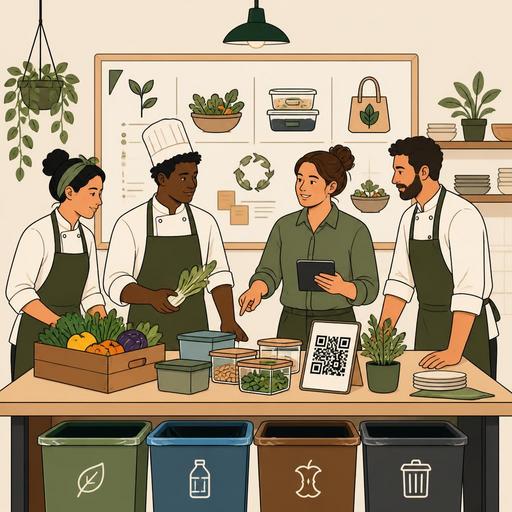
A Plan to Reduce Waste in the First 90 Days of a Sustainable Restaurant
Sustainable restaurant management is not only an environmental stance; it is also a powerful framework for cost control, operational discipline, and a more consistent customer experience. The first 90 days in particular are critical for taking a zero-waste approach beyond being a slogan and embedding it into daily operations. The goal in this period is not to become flawless all at once; it is to make visible where what is being wasted, to measure it, and to make small but lasting improvements.
When sustainability comes up, many businesses think only of straws, packaging, or sorting trash. Yet a large part of a restaurant's waste most often arises from disconnects in purchasing, the prep plan, the portion standard, the menu design, and the order flow. For this reason, the first 90-day plan should address the kitchen, service, register, and supply processes together.
1. First 30 days: Don't guess the source of waste, make it visible
The main goal of the first month is to be able to answer the question "where do we waste the most?" with data rather than intuition. You don't need a complicated system to do this; regular record-keeping and clear categories are enough.
Track waste under three main headings
- Production waste: Over-chopping, incorrect prep, spoilage, products past their use-by date.
- Plate waste: Products the customer doesn't finish, items returned because of large portions.
- Operational waste: Wrong orders, cancelled items, double production, faulty packaging.
For example, let's consider a cafe-restaurant: if, at the end of the day, sandwich bread, greens, and garnish go in the trash the most, the problem may not be purchasing alone. Perhaps the amount of prep made for the lunch rush is getting mixed up with the evening demand. Or a few low-turnover items on the menu are also spoiling the freshness of the high-volume products.
At this stage, set up a 5-minute record routine at the end of each shift. Which product, why was it discarded, at what hour did it occur? If orders are tracked digitally, it becomes much easier to see which products are frequently cancelled, which ones are modified, and at which hours demand drops. The QR menu, order management, and the POS flow working together is important here; because waste most often starts not just in the kitchen, but at the moment the order decision is made.
Questions you should look at in the first 30 days
- Which 10 products produce the most waste?
- Which products sit on the menu but sell little?
- In which time window is too much prep done?
- On which channel do wrong orders most often occur?
- Which products are returned with the most leftover portion?
At the end of the first month, aim not for a perfect report, but for a visibility that drives decisions. Because waste that isn't measured is quickly accepted as "normal" within the team.
2. Days 31-60: Simplify the menu and prep plan so they don't produce waste
In the second month, the focus is reflecting the problems you've identified onto the menu and production order. The biggest mistake on the zero-waste journey is trying only to "reduce what goes in the trash" without questioning the menu itself.
Read menu engineering from a sustainability angle
A product may be much loved; but if it requires three different low-turnover ingredients behind it, it can increase total waste. Similarly, offering a large number of variations on the menu may look like freedom to the customer, yet it can lead to stock fragmentation in the kitchen.
A concrete example: if grilled chicken salad, a chicken wrap, and a chicken bowl use the same main protein, the supply plan can be made more balanced. By contrast, an exotic sauce used in only a single special dish constantly produces waste at low sales. In this case, rather than removing the product entirely, integrating the sauce into two other products may be smarter.
- Create a shared ingredient pool.
- Low-turnover products should either be removed from the menu or repositioned.
- Clarify the portion standard on a grammage basis.
- Use the dish of the day approach to plan a deliberate use of safe leftover ingredients.
Digital menu management provides a serious advantage here. Inefficient products that stay on a printed menu for months can be updated more quickly on a digital menu. Adjusting product visibility instantly when there's a seasonal change, a stock situation, or a supply disruption reduces both wrong orders and unnecessary prep pressure.
Tie the prep plan to the sales rhythm
Many businesses prepare the same recipe in the same amount every day. Yet variables such as weekday versus weekend, lunch versus dinner, and a rainy day versus a match day significantly affect the prep need. Businesses that can track past order flow give a more realistic answer to the question "how much should be prepared?"
By the end of the second month, your goal should be to move from a "many-option but uncontrolled" structure to a "simpler but stronger" menu.
3. Days 61-90: Tie the team to the process and standardize daily decisions
The sustainable restaurant model doesn't run on the goodwill of the chef or the business owner alone. If the shift supervisor acts one way, the kitchen another, and the service team another, waste comes back. What needs to be done in the third month is to take the system out of being dependent on individuals.
Set workable micro-standards for the team
Long procedure files become shelf decoration in most restaurants. Instead, task-based, short, and clear standards are more effective:
- Before prep begins, the current stock is checked.
- At the end of each shift, the reason for waste is marked with three codes.
- For returned plates, a note is made on whether the portion or the flavor was the problem.
- To reduce the risk of wrong items in takeaway orders, a final check step is applied.
- Low-stock or critical products are flagged visibly in the digital system.
For example, if the service team notices a large-portion product that is frequently left half-finished, this information should reach the kitchen and the menu manager. Otherwise, the same product is assumed to be "selling well" for weeks, when in fact it produces plate waste. Real improvement begins where operational data and customer feedback come together.
At this point, being able to track reservation, order, and sales data in a single flow makes the manager's job easier. Instead of looking for answers to questions like which day is busier, which product speeds up at which hour, and which stock item is becoming risky, one by one through text messages or paper notes, you need to set up a central operational view.
4. Announce your sustainability to the customer, but don't overdo the show
The customer side is most often handled incorrectly. Big claims, vague environmental rhetoric, or sharp statements like "completely zero waste" can create a trust problem. Instead, describe the practices you genuinely follow in a simple way.
For example, the digital menu can provide clear information such as: the use of seasonal products, a portion option, single-use items not being added by default in packaging, and limited daily production of certain products. These both manage expectations and create a positive perception with the conscious customer.
Small designs that don't disrupt the customer experience matter, too. The approach "let us add a napkin if you'd like one" is healthier than the tone "we don't give out napkins because we're sustainable." The goal is not to put the sacrifice on the customer, but to reduce waste intelligently.
5. What outcomes should you expect at the end of the first 90 days?
Don't expect everything to be flawless at the end of the first 90 days. But the following gains should become visible:
- The products that create the most waste should have become clear.
- The menu should have been simplified or repositioned.
- Prep amounts should move in a more controlled way on a day-and-hour basis.
- Operation-driven waste, such as wrong orders and double production, should decrease.
- The team should see waste as a "manageable" matter rather than an "inevitable" one.
Sustainability is most often treated as a separate project in restaurants. Yet the best result comes when you embed it into purchasing, menu design, the order flow, stock management, and service quality. The success of the first 90 days lies exactly here: building a more predictable operation while producing less waste.
Seeing menu, order, and operational data in one place with digital tools like Restomas can help you tie your sustainability goals to the daily workflow more naturally.
