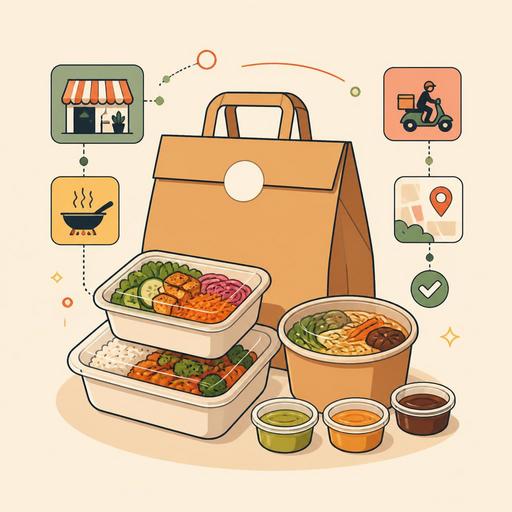
How Does the Packaging Experience in Takeaway Affect Customer Loyalty?
The packaging experience in takeaway service is a more powerful driver of customer satisfaction than most restaurants assume. Even when the food tastes great, spilled sauces, soggy items, mixed-up orders, or a package that looks messy when opened can drag down the entire experience in the customer's mind. Especially in moments when delivery proceeds beyond the restaurant's direct control, packaging becomes a silent touchpoint that carries product quality, brand perception, and the likelihood of reordering.
A customer dining at the table is won over by presentation, the welcome, and the flow of service. In takeaway service, however, the first physical contact most often begins with the bag, box, lid, label, and internal arrangement. For this reason, seeing packaging merely as a transport material is an incomplete approach. The right setup both organizes the kitchen operation and reinforces the customer's sense that "this business pays attention to detail."
Why is packaging not just protection but a part of the experience?
In a takeaway order, the customer evaluates the product not as it left the kitchen but as it arrives after its journey. In other words, packaging serves as a bridge between product quality and the condition at the moment of delivery. If this bridge is weak, even a well-prepared dish can be perceived poorly.
For example, a product that should stay crispy can quickly turn soggy when placed in a fully sealed box that traps steam. Carrying a grilled item together with a salad in the same package can upset the temperature balance. A loose soup lid can lead not just one item but the entire order to be perceived negatively. The customer often does not distinguish "was the courier late, or did the kitchen pack it wrong?"; they remember the experience as a single whole.
The important point here is this: packaging affects satisfaction even without changing the taste of the food. Because the customer buys not only the flavor, but also the orderliness, the sense of hygiene, the ease of use, and the care taken.
Details the customer notices but the business often overlooks
Restaurant owners often evaluate packaging on a unit-price basis due to cost pressure. Yet the hidden cost of low-quality choices can be returns, compensation orders, low ratings, negative reviews, and lost reorders. The following details in particular are quickly noticed on the customer's side:
- Not separating hot and cold items: Dessert, a drink, and a hot main course arriving in the same bag lowers the perception of quality.
- Missing labels: It is unclear which product belongs to whom, whether spicy sauce was added, or whether a special note was applied.
- Spillage during transport: Containers with loose lids and improper internal arrangement put the entire order at risk.
- Difficulty opening and closing: Overly stiff lids, tearing bags, or unstable containers undermine ease of use.
- Unnecessary bulk: Using excessive packaging for each item can create a sense of both waste and disorder for the customer.
Consider a concrete example: in an order of a burger, fries, and a drink, even if the burger box is sturdy, the fries steam up because they are kept sealed, the drink tips over inside the bag because it is not secured well enough, and the napkin and sauce are wedged at the very bottom. In that case the order is coded as "careless" in the customer's mind. The problem here is not in the recipe but in the packaging setup.
The right packaging decision must be considered together with the menu structure
Not every product can be transported with the same packaging logic. For this reason, takeaway packaging selection should be treated as a natural extension of menu management. The restaurant needs to provide clear answers to questions such as "which are the best-selling products, which items generate the most complaints, and which product loses its form on the way?"
For example, instead of seeking a single solution for noodles, bowls, soupy dishes, fried food, pizza, and dessert, a product-based scenario should be built. Fried items need air circulation, while saucy products demand leakproof priority. In breakfast packages, the risk of crushing comes to the fore, whereas with desserts, visual integrity may be more critical.
At this point, digital order management provides a significant advantage. Order notes reaching the kitchen in full, product-based packaging instructions being standardized, and the margin of error being reduced during busy hours all directly affect packaging performance. For example, defining operational notes within the system for specific products, such as "transport upright," "sauce on the side," "add cutlery," or "split into two bags," reduces staff having to make judgment-based decisions.
QR menu and digital menu infrastructure also contribute indirectly. Because it is possible to avoid highlighting products unsuitable for takeaway on the menu, to create a delivery version for certain products, or to offer add-on options in a more controlled way. This establishes a more realistic balance between the kitchen and the delivery experience.
5 actionable steps to improve packaging quality
You do not need a major overhaul to improve the packaging experience. Most businesses can create a noticeable difference with a few systematic steps:
- Classify products by delivery durability. Sort the products on your menu as "high risk," "medium risk," and "durable." Fix the items that cause the most problems first.
- Put the packaging standard in writing. Be clear about which product goes in which container, with which label, and in which order it is bagged. Do not rely on the knowledge of an experienced staff member.
- Run a peak-hour test. Every system looks good when the kitchen is calm. The real test is whether orders go out correctly and in order during the evening rush.
- Categorize customer reviews. Do not leave comments like "it came cold," "it was a mess," "the sauce was missing" in a single pool; track packaging-related issues separately.
- Think about the courier delivery scenario. Choose packaging by imagining it not only on the kitchen counter, but also in the motorcycle bag and at the building entrance.
The goal here is not to buy more expensive packaging, but to build a more accurate packaging system. Sometimes a small internal divider, sometimes a disposable label, and sometimes changing the order of the products can be the most effective solution.
Operational efficiency and customer satisfaction meet at the same point
The topic of packaging should not be evaluated only under the heading of customer experience. The right packaging standard reduces decision fatigue in the kitchen, makes it easier for new staff to adapt, and lowers the chance of error per order. Especially in restaurants that take orders across multiple channels, when the order flow is not gathered on a single screen, packaging notes can get lost and a chain of errors begins.
For this reason, restaurants should not consider takeaway performance separately from the kitchen operation. When order management, product notes, off-premise sales flow, stock alignment, and menu updates all proceed within a single digital order, packaging quality also becomes more consistent. If a product is temporarily out of stock, no false promise is made to the customer; add-ons appear clearly; and staff can more easily track which order went out with which special request.
Ultimately, the package that reaches the customer's hands is the restaurant's silent presentation. Packaging that preserves the flavor, conveys a sense of order, and is easy to use often produces satisfaction without being noticed. Bad packaging, on the contrary, can render good kitchen effort invisible. For businesses that want sustainable satisfaction in takeaway service, the right question is not "which box is cheaper?" but "which packaging experience supports a reorder?"
Restomas can help restaurants make their takeaway experience more consistent by managing menu, order, and operational flow in a more organized way.