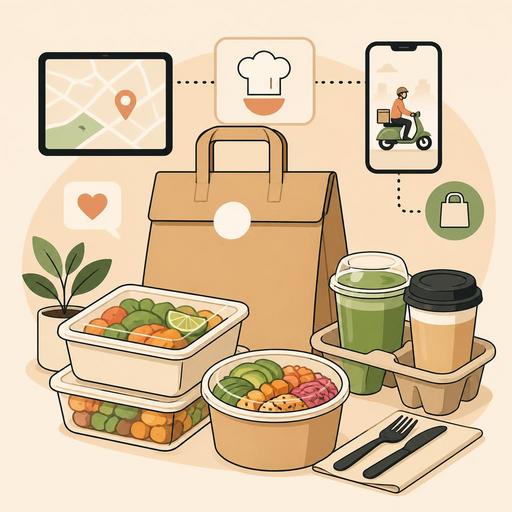
The Effect of Packaging Quality on Customer Satisfaction in Takeaway
When the topic of takeaway packaging and customer satisfaction comes up, many businesses think only of leak-proof containers or cost. Yet packaging is a quiet but very powerful part of the relationship the customer builds with the restaurant. Food arriving hot, sauces not spilling, the product not getting crushed, the package looking tidy, and the unboxing experience being practical determine perception as much as the order's taste does. Especially now that delivery platforms have become widespread, the customer often evaluates the restaurant first through the packaging and then moves on to the food.
A customer receiving table service is won over by the plate, the presentation, the speed of service, and the atmosphere. In takeaway, packaging takes the place of these touchpoints. For this reason, the right packaging choice is not just an operational detail; it is a management topic that influences brand perception, return risk, review quality, and the likelihood of reordering. What's more, the point here is not to use expensive packaging but to build a system suited to the product type and operational flow.
Why does packaging speak before taste?
When the customer takes the package in hand, they have not yet tasted the food, but they have already begun forming their first impression. A bag with a grease stain, a carrier bag soaked by a beverage, mixed-up sides, or boxes squeezed on top of one another create a sense of carelessness from the very first moment. Conversely, packaging that is neatly arranged, easy to open, separates the products from one another, and protects the food shows that the business has the process under control.
The important point here is this: the customer often does not describe the problem they experienced as "the packaging was bad." Instead, they say "the burger was soggy," "the fries were stale," "the soup spilled," or "the dessert was crushed." Yet a significant portion of these complaints are directly related to packaging and packing decisions. In other words, packaging is an invisible carrier of quality.
- Temperature retention determines the product's perception at the first bite.
- Moisture management prevents texture loss, especially in fried and baked products.
- Compartmented placement keeps flavors from mixing into one another.
- Leak-proofing increases both the hygiene perception and delivery confidence.
- An easy-to-open structure quietly improves the customer experience.
Not every product can take the same packaging: you need to think by category
One of the most common mistakes in takeaway is trying to fit the entire menu into a few standard boxes. Although this approach looks easy on the supply side, it creates problems in the customer experience. That is because pizza, burgers, ramen, salad, dessert, and a breakfast plate do not have the same carrying conditions. For example, fried products quickly turn soggy in fully closed boxes with no air outlet. With saucy products, loose lids can create a leak with even a small movement during transport.
Let's think concretely. In a burger meal, sending the burger, fries, and sauce in the same wide box may seem practical. However, in this case the burger steams, the fries draw moisture, and if the sauce lid opens, the bread gets soggy. Instead, it is more correct to use a separate box that preserves the burger's structure, a solution that allows air circulation for the fries, and a stable small container for the sauce. Likewise, carrying a hot dish and a cold dessert in the same bag ruins the experience of both products.
For this reason, restaurants should ask the following questions on a per-menu basis:
- Should this product be carried hot, warm, or cold?
- Does it produce moisture, or does it lose its crispness?
- Is there a risk of it tipping over or being crushed during transport?
- Should the sauce, side, or extra ingredient go separately?
- Will the customer be able to take the product out of the package easily?
The answers to these questions make packaging a topic that the kitchen and operations team should determine together, not the purchasing department.
Packaging mistakes wear down operations more than they appear to
Packaging does not only produce results on the customer side; it also directly affects the kitchen flow and staff performance. Unsuitable containers lengthen packing time, products are re-prepared, order checking becomes harder, and problems arise during courier handover. Especially during busy hours, these seemingly small hiccups accumulate and lengthen service time.
For example, boxes whose lids close with difficulty waste time at the packing station. Unlabeled packages increase the risk of wrong delivery. In carriers without beverage stabilization, staff scramble at the last moment to come up with an extra measure. The result is not just a few spilled drops; it is stress in the kitchen, rework, and customer complaints.
Digital processes provide important support here. Showing product-based packing notes on the order screen standardizes which product goes out with which container. For example, when rules such as "sauce separate," "carry beverage upright," "double-check soup lid," or "place dessert on top" are written into the digital flow, dependence on staff memory decreases. Especially for businesses managing multiple branches, this standardization makes packaging quality independent of the individual.
An actionable packaging control system for customer satisfaction
Restaurant owners should treat packaging not as an abstract quality heading but as a measurable process. This does not require a complex system; clear checkpoints are enough.
1. Create a product-based packaging matrix
For each product on the menu, list the container, lid, bag, beverage-carrying solution, and any necessary warning notes to be used. This way, the standard is preserved even when the shift changes.
2. Use a short checklist at the packing station
- Did the lid close completely?
- Were hot and cold products separated?
- Were the sauces secured?
- Was the label-to-order match checked?
- Is the bag's carrying weight balanced?
3. Classify complaints by cause, not by product
Open headings such as "spilled," "got soggy," "got crushed," "got mixed up," and "got cold." This way, you can see more clearly whether the problem originates from the kitchen, the courier, or the packaging.
4. Place a test order
Place test orders for different products at different times from your own restaurant. How does the package look at the door, how does it feel when opened, in how many minutes does the product lose its texture? These things are hard to understand from the inside.
5. Update menu engineering for delivery
Some products may be very successful in the dining room but do not deliver the same performance in takeaway. For products that persistently cause problems, the recipe, portion, sauce structure, or presentation style should be revised.
Good packaging does not mean expensive packaging
Many businesses think the only way to improve packaging quality is to raise the cost. Yet most of the time, the real need is not more expensive material but more correct matching. The right container choice, the correct packing order, separating the products, and standard instructions yield better results than most expensive but wrong solutions.
For example, for a product with a high leak risk, neat placement and an upright-carry note can be more effective than a single-layer bag. For fried products, choosing a structure that provides controlled air outlet instead of a fully closed box can improve quality. With beverages, in-bag stabilization is as important as lid security. In other words, cost optimization comes not from choosing the cheapest option but from reducing the cost of problems.
In the long run, a well-designed packaging system lowers invisible costs such as returns, re-shipments, negative reviews, and customer loss. The restaurant's gain forms exactly here: fewer problems, a more consistent experience, and a more trustworthy brand perception.
Conclusion: Packaging is the invisible service staff of delivery
In takeaway, packaging is not just a vehicle that carries the food; it is a silent touchpoint that protects the presentation, conveys a sense of hygiene, defends product quality, and communicates the brand's level of care. When restaurants manage packaging as part of customer-experience design rather than as a purchasing line item, they encounter fewer complaints, more consistent delivery quality, and stronger reordering behavior.
With Restomas, by making your order flow and product-based operational notes more standard, you can manage the takeaway experience in a more controlled way from the kitchen all the way to the door.