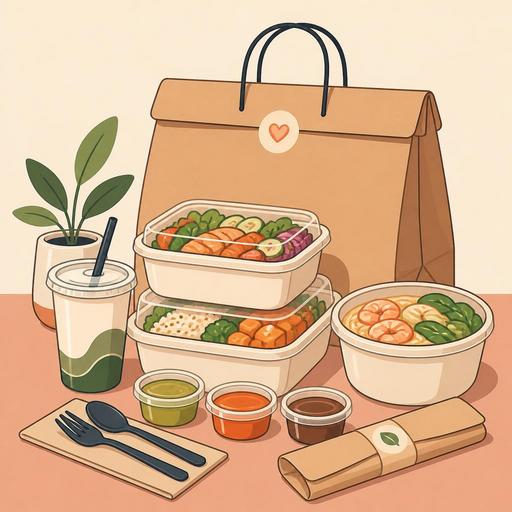
How Packaging Quality Shapes the Customer Experience in Takeaway
Packaging quality in takeaway is one of the most critical touchpoints where the customer experiences your restaurant not at the table but at home, at the office, or on the go. Even if the flavor is good, spilled sauce, soggy fries, a sweaty lid, or jumbled products quickly drag down the customer's perception. For this reason, takeaway packaging is not merely a means of transport; it is an operational element that protects product quality, conveys the brand, and influences the decision to reorder.
Why is packaging a satisfaction factor independent of flavor?
Restaurant owners often evaluate customer satisfaction through the recipe, portion, and delivery time. Yet in the takeaway experience, the customer decides first with their eyes the moment they receive the order. The box looking crushed, the lid not closing fully, oil seeping to the outer surface, or products touching each other in the same container affect the perception of quality in the very first seconds.
For example, using a container that completely seals off air circulation for crispy battered products can cause the product to go soggy within a few minutes. Sending grilled products and a salad garnish in the same compartment disrupts the hot-cold balance. And a soup lid not closing securely can ruin the entire experience in a single order. The customer often interprets these problems not as a "packaging error" but directly as "the restaurant's quality is low."
The important point here is this: the packaging's job is not only to transport the product but to preserve the standard that came out of the kitchen up to the moment of delivery. For this reason, good packaging is an extension of kitchen quality.
Not every product should be sent in the same packaging: matching to the menu is essential
One of the common mistakes made in takeaway is sending different product groups in similar containers. Yet a burger, pizza, bowl, dessert, soup, and fried items all have different physical needs. Packaging choice should be addressed as part of menu engineering.
Basic criteria you should think about per product
- Heat retention: Hot products should stay hot, cold products cold.
- Moisture management: Containers without steam venting can ruin crispiness.
- Leak-proofing: Critically important for saucy, oily, and liquid products.
- Compartmented structure: Reduces contact between garnish, sauce, and the main product.
- Transport durability: It should hold its form during courier movement.
Let's give a concrete example: when a menu consisting of chicken pilaf, ayran, and dessert is placed randomly into a single bag, the risk of heat transfer and crushing rises. But when a heat-retaining container is used for the pilaf, a stabilizing transport arrangement for the ayran, and a separate protected section for the dessert, the customer perceives the order as more organized. This small difference strengthens the sense of a "meticulous business."
Similarly, adding sauces into the product in advance isn't always right. For some products, sending the sauce separately preserves the consistency and texture. Standardizing which product comes out in which packaging and with which layout reduces differences between branches and lightens the decision burden on staff.
Packaging problems often begin not in the kitchen but in process design
Many businesses attribute the packaging problem to supplier quality. Yet the problem often emerges in the order flow, the packing sequence, and a lack of checks. A lid closed at the wrong time, a hot product waiting too long, incomplete labeling, or the unnecessary time that passes before courier handoff lowers packaging performance.
For this reason, in the takeaway operation you should ask not only the question "which box" but also "what's being done at which step." The following arrangement makes a big difference, especially during busy hours:
- The order drops onto the screen clearly and completely.
- Product groups are separated according to preparation priority.
- Packaging types are positioned in an organized way at the packing station.
- A short final checklist is applied for each order.
- Leak-proofing and content verification are done before courier handoff.
Digitization comes into play here. Scattered order notes, special requests being overlooked, and leaving the product-packaging match to personal memory increase the error rate. Order management screens, product-level notes, and systems that simplify the kitchen flow make it easier to maintain the packing standard. Platforms focused on restaurant digitization, like Restomas, can support this standard by helping you build a more visible process up to the order's exit from the kitchen.
The invisible details that increase customer satisfaction
The packaging's impact isn't only damage-free delivery. The customer often remembers small but meaningful details. Practices such as including a wet wipe, marking sauces correctly, taking allergen-sensitivity notes into account, and separating hot and cold products send a strong signal of care.
For example, in products such as noodles, soup, or saucy pasta, ease of opening is as important as lid security. Containers that close too tightly or splash when opened create a negative experience. With desserts, visual integrity matters; even if the flavor is good, a scattered presentation lowers the product's value. With coffee and drinks, the stability of the lid and the choice of carrier accessory can be a cause of complaint or satisfaction on their own.
At this point, businesses need to read customer feedback more intelligently. The comment "the fries were stale" sometimes results not from the frying technique but from moisture accumulating in the container. And the complaint "the burger fell apart" may be a wrong-placement or transport issue more than a production error. In other words, comments should be evaluated not only as kitchen performance but within the product + packaging + delivery triad.
An actionable packaging improvement plan for restaurant owners
The cliche suggestion to "buy higher-quality boxes" isn't enough on its own. A better approach is to set up a menu- and operations-based testing process. The plan below can be applied practically:
- Classify the menu: Group crispy, liquid, layered, cold, and delicately presented products separately.
- Set a packaging standard for each group: Choose according to the product's need rather than a single type of container.
- Apply a 30-minute transport test: Evaluate the product under conditions similar to real delivery.
- Set up a packing station: Fix the packaging, label, sauce, and check flow.
- Categorize complaints: Track them under headings such as spillage, sogginess, missing item, and mixing.
- Standardize digital order notes: Make critical notes such as "sauce separate," "carry drink upright," and "dessert on top" visible.
This approach reduces not only customer dissatisfaction but also the refund and remediation burden. It also speeds up operations because it doesn't require staff to rethink every order. In multi-branch structures, the brand experience becomes more consistent thanks to standard packaging instructions and a digital order flow.
In conclusion, takeaway packaging is the restaurant's invisible but powerful service staff. It doesn't speak, it doesn't do marketing; but by determining how the food arrives, it quietly manages customer perception. Businesses that build a packaging system that preserves flavor, gives a sense of order, and delivers the order safely often make the difference in takeaway exactly here.
By making the order flow and operational standards more visible, Restomas offers a simple digital foundation for restaurants that want to manage the takeaway experience more consistently.
