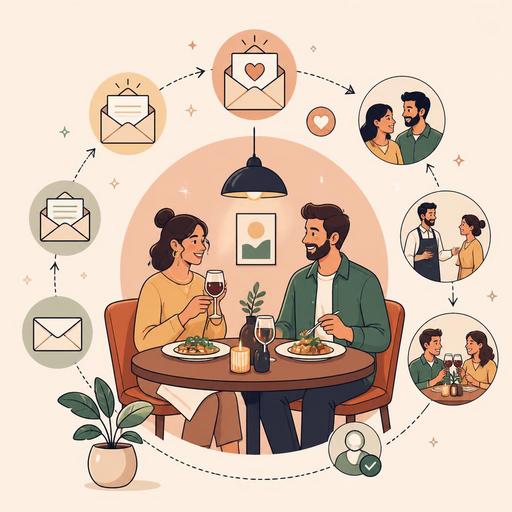
A Win-Back Email Series for Lapsed Restaurant Customers
Why is a win-back email sequence critical in restaurants?
A win-back email sequence is a planned communication series designed to re-engage customers who haven't ordered, made a reservation, or visited your venue for a while. For restaurants, the matter isn't just about sending a discount coupon; the real point is understanding why they were lost, re-establishing contact at the right time, and managing the return operationally without a hitch.
If a customer came once but didn't come a second time, the problem isn't always food quality. Wait time, slow service during busy hours, not finding what they were looking for on the menu, the difficulty of the reservation experience, or simply having forgotten you can all play a role. For this reason, an effective win-back design rests as much on reading customer data correctly as on the marketing copy.
Especially businesses with a QR menu, order history, reservation records, and table-based operational data can see more clearly which customer lapsed and when. This kind of visibility makes it possible to create different scenarios based on behavior instead of sending everyone the same email. This both reduces communication fatigue and increases the chance of a return.
First step: define the lapsed customer correctly
In a restaurant, the definition of a "lost customer" should not be one-size-fits-all. Someone who buys a coffee once a week is not evaluated the same way as a customer who comes once a month for dinner. For this reason, before building a win-back sequence, you need to separate your customer groups according to your own business model.
Practical segmentation examples
- A regular customer who hasn't come in the last 30 days: People who normally come often but have suddenly stopped.
- A new customer who didn't return after their first visit: People whose first experience didn't turn into a second visit.
- A high-basket but long-inactive customer: They come less often but spend a lot when they do.
- A customer interested only in a specific category: For example, those behaving in a breakfast-, dessert-, vegan-menu-, or cocktail-focused way.
The important thing here is not to limit segmentation to just the "when did they last come" information. For example, if a customer comes only for weekend brunch, sending them a Tuesday lunch campaign may be meaningless. Likewise, for a customer who orders spicy food, a quick-delivery or easy-reorder advantage makes more sense than a dine-in-experience-focused message.
The clear action for restaurant managers is this: first look for a repeat-visit pattern in your POS, reservation, and digital menu data. Sift out which day, which hour, which product group, and which channel the customer interacted with you through. Win-back success is built on this foundation before the beauty of the email.
How do you build a 4-step win-back email sequence?
An effective sequence is not a single message. You need a flow that complements itself, answers different objections, and gradually gives the customer a reason to return. The structure below offers an applicable framework for restaurants.
Email 1: A reminder and a gentle invitation to return
The purpose of the first message is not to sell, but to re-establish the relationship. Your tone shouldn't remain as generic as "We've missed you"; it should connect with the customer's previous experience. For example, you could remind brunch regulars about a new-season breakfast plate, dinner guests about the chef's changing specials, and takeaway users about an easy reorder flow.
In this email, the following elements are more effective than an aggressive discount:
- A new menu or seasonal flavor announcement
- Ease of reservation
- A refreshed service experience
- Short recommendations for the category they like
Email 2: Asking for feedback
If there's no response to the first message, the second contact can be more valuable: the question "Did we get something wrong?" Many restaurants skip this step; yet any incentive offered without understanding the reason for the loss is just a guess. Set up a short, low-friction feedback flow. Instead of long surveys, use reasons that can be selected with a single click: service speed, price perception, menu variety, location, reservation difficulty, delivery experience, and the like.
This step also produces operational insight. If similar complaints begin to cluster at a particular branch, the problem may be field management rather than marketing.
Email 3: A personalized offer
In the third message, a concrete reason to return can now be offered. However, here a behavior-based offer makes more sense than the classic "discount on everything" approach. For example:
- For those who ordered dessert on their last visit, an invitation to a dual experience along with the new dessert menu
- For weekday lunch customers, a quick-service menu
- For takeaway users, one-click reorder convenience
- For reservation-based dinner customers, table priority during quiet hours
Your offer should not be based on price alone. Sometimes priority reservations, fast access to a fixed favorite order, an invitation to try a new product, or a special-day reminder works more powerfully.
Email 4: A final touch and preference update
If there's still no response, the final email should be a respectful closing rather than one that applies pressure. Give the customer the chance to update whether they want to receive messages, which content they're interested in, and how often they'd like to hear from you. This step preserves list quality and closes the process without damaging your brand's perception.
Common mistakes made when writing the content
Win-back sequences can very easily become clichéd and ineffective. The most common mistake in restaurants is sending the same email to all silent customers. Yet someone who comes with their family in the evenings and a person who grabs a coffee alone aren't won back with the same language.
- Being discount-focused only: This can turn your brand into a place bought from for the campaign rather than at the expected price.
- Being late: An email sent months after the customer has forgotten you struggles to revive the relationship.
- Launching a campaign while operations aren't ready: If the customer you invited by email experiences the same old problem the moment they arrive, winning them back becomes even harder.
- Not considering the mobile experience: The email opens, but if reservation, menu viewing, or the ordering step is difficult, the return rate drops.
At this point, marketing and operations need to work together. For example, the products highlighted in the email should be easy to find on the QR menu, the reservation flow should be short, and the campaign products should be clearly defined on the POS side. Otherwise, a good email opens onto a bad experience.
Measurement: which metrics should you look at?
Evaluating win-back success by looking only at the open rate is incomplete. For restaurants, the real question should be, "Did the customer come back, and how did their behavior change after they returned?"
The main areas to track are as follows:
- Returning-customer rate: Among those who received the email, the ones who made a reservation, placed an order, or visited.
- Time to repeat visit: How long after the message the return occurred.
- Channel-based return: The difference between the dine-in, pickup, takeaway, or reservation channel.
- Offer-based performance: Which message and which offer brought a higher-quality return.
- Second repeat: Whether the returning customer came once more, or returned only for the campaign.
The most critical point here is to see not just whether the campaign created momentary traffic, but whether it created a lasting habit. If a segment responds only to discounted messages but disappears in normal periods, your problem isn't communication; it's your value proposition.
An applicable 30-day plan for restaurant owners
You don't need a large team to set up this system; the right sequence is enough.
- Week 1: Build customer segments based on last-visit date, order type, and basket behavior.
- Week 2: Write a 4-email flow for each segment; one a reminder, one feedback, one an offer, one a preference update.
- Week 3: Check that the products mentioned in the emails are flawlessly defined on the menu, reservation, and POS side.
- Week 4: Run a test on a small segment; track which channel the returning customers came through and improve the copy accordingly.
The best win-back email is one that doesn't give the customer the feeling of "I've been sent a mass message." In restaurants, the key to recovery is the alignment of data, timing, and the experience on the floor. If digital menu, reservation, and order data are read within a single operational logic, it becomes much easier to reach a lapsed customer at the right moment and with a more meaningful reason.
Digital restaurant tools like Restomas, by viewing these touchpoints in a more orderly way, can help you make the win-back process more measurable.
