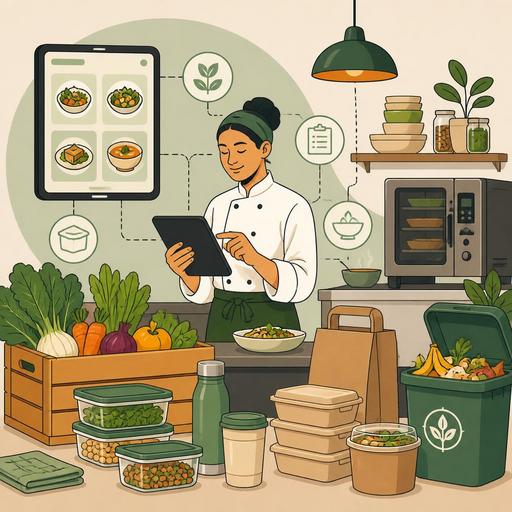
A First-90-Days Plan to Implement for a Zero-Waste Restaurant
Why are the first 90 days decisive in the sustainable restaurant goal?
The zero-waste restaurant approach is not only an environmental stance; it also means cost control, operational discipline, and a more consistent customer experience. Many businesses start the topic of sustainability with good intentions; but when no measurement is done, when tasks are not clearly defined, and when the team cannot embed it into the daily routine, the process falls apart quickly. For this reason, the first 90 days should be seen not as a period of major investment but as a period of building the right habits.
In restaurants, waste does not form at a single point. Trimming losses during preparation, stock spoiling due to wrong purchasing, plates returned during service, buffets or wrong portioning, unnecessary packaging use in takeaway, and products that rarely sell remaining unused all feed into one another. The first step of the zero-waste journey is giving an honest answer to the question "where do we lose the most?"
The good news: you do not need to rebuild the entire business from scratch in the first 90 days. Small but continuous steps, such as flagging products that generate high waste, reviewing low-turnover items on the menu, or making the order flow more visible, make a difference within a few weeks. Especially systems that make the digital menu, order management, and stock-related operations more trackable help the team act on data rather than guesswork.
The first 30 days: don't guess at waste, make it visible
The goal of the first month is not to be flawless but to clarify the picture. Many businesses think "our biggest problem is packaging" or "the real loss is in vegetables"; but when records are kept, it can turn out that the real problem is menu complexity, a wrong production plan, or the portion standard.
An actionable checklist for getting started
- Separate waste into three headings: prep waste, service/return waste, and stock loss from spoilage.
- Identify the 10 products that go in the trash the most: especially greens, bread, dairy products, sides, and low-turnover sauces.
- Create a shift-based record: the morning prep and the evening closing loss may not be the same.
- Note the reasons for returns: oversized portion, wrong cooking, wait time, wrong product output.
- Review packaging use: separate out the materials that are genuinely necessary in each takeaway order.
Let's give a concrete example: when a café turns the arugula and parsley constantly left over on breakfast plates into a "we won't add it unless the customer wants it" option, it can reduce both prep waste and plate-return waste. A burger restaurant, on the other hand, can produce more controlled output by turning the large portion of fries that is added automatically but left half-eaten in most orders into a two-option choice. The critical point here is to make the decision through regular observation, not intuition.
At this stage, the advantage of digital menus is great. Updating product descriptions, adding options, clarifying the side preference, or quickly deactivating a low-demand product is far more nimble than with a printed menu. This way, the menu turns into a living operational tool that reduces waste.
Days 31-60: redesign the menu and production to reduce waste
In the second month, you need to turn the data into action. The most common mistake in sustainable restaurant management is thinking of waste only as a matter of kitchen discipline. Yet a significant part of waste arises from menu design. Menus full of disconnected, low-turnover, high-prep-load products that do not use common ingredients increase waste.
Questions to ask for menu simplification
- Does this product sell regularly, or does it just create menu clutter?
- In which other dishes is the ingredient bought for this product used?
- Is there a high trimming or spoilage risk in the preparation process?
- Can the portion standard be applied easily by the team?
- What change does the customer request most for this product?
For example, a special sauce used in only a single salad creates a spoilage risk if it is not consumed regularly. If there is a way to use the same ingredient in sandwiches, bowls, and main dishes, purchasing becomes more rational. Likewise, focusing on the highest-turnover and production-plannable options instead of a very broad dessert menu can reduce daily waste.
Here portion standardization also plays a critical role. "Eyeballed" production increases waste during busy hours. A scoop measure, a gram card, prep labels, and short station-based production notes preserve consistency even when the team changes. Product notes appearing clearly on the order management screens also reduce waste caused by wrong preparation. Every wrongly produced plate is a loss not only of food but of time, energy, and labor.
Another adjustment that can be made in the second month is bringing reservation and demand forecasting closer to the kitchen plan. If the weekend brunch density, the lunch set-menu demand, or the evening takeaway peaks can be anticipated, the risk of overproduction drops. Seeing demand better reduces overpreparing with a "just in case" mindset.
Days 61-90: bring the team, sourcing, and customer communication together under the same goal
The third month is the period of building a lasting system. By now you should know more clearly which products cause problems, at which hours the production balance is disrupted, and which menu items consume resources. From this point on, success depends on the team taking ownership of this goal.
What needs to be clarified on the staff side
- Who is responsible for the waste record on each shift?
- How will returned products be classified?
- How will the safe products left over at the end of the day be used?
- According to which thresholds will purchasing orders be placed?
- In which situations will the decision be made to disable a product on the menu or suggest an alternative?
At this stage, communication with suppliers is also important. Smaller but more frequent deliveries can reduce the spoilage risk for some businesses. Supply of usable fruits and vegetables with a non-standard appearance can be put to use in soups, sauces, or daily dishes. Of course, quality and food safety are not up for compromise; the aim is simply to wisely plan usable products rejected only because of their appearance.
Customer communication is also a part of sustainability. For example, offering a fork, napkin, or extra sauce in a takeaway order as an option rather than a default both reduces waste and gives the customer a sense of control. It is easy to present these preferences clearly in digital order flows. Likewise, emphasizing seasonal products on the menu, featuring limited-production daily options, and updating sold-out products in real time make operations and communication consistent.
Which metrics should you look at at the end of the first 90 days?
On the zero-waste journey, do not evaluate success only by the feeling that "less trash seems to have come out." Every business should set a few core metrics suited to its own scale. Even if you cannot build a formal reporting system, regular tracking raises the quality of decisions.
- Is the number of products generating the most waste decreasing?
- Are the main reasons for returned plates recurring?
- Have the low-turnover menu items been cleaned up?
- Has unnecessary packaging use in takeaway orders dropped?
- Has the rate of product cancellation or loss due to stock spoilage declined?
The aim here is not perfection but making recurring losses visible and manageable. At the end of the first 90 days, you will most likely notice this: sustainability is a business model that starts in the kitchen but is completed with menu management, reservation planning, the order flow, staff discipline, and customer communication. This is why digitalization and the zero-waste goal are not separate topics; used correctly, they are parts of the same operational mind.
Digital tools like Restomas can make this transformation more manageable for restaurants looking to speed up menu updates, make the order flow visible, and make operations more measurable.
