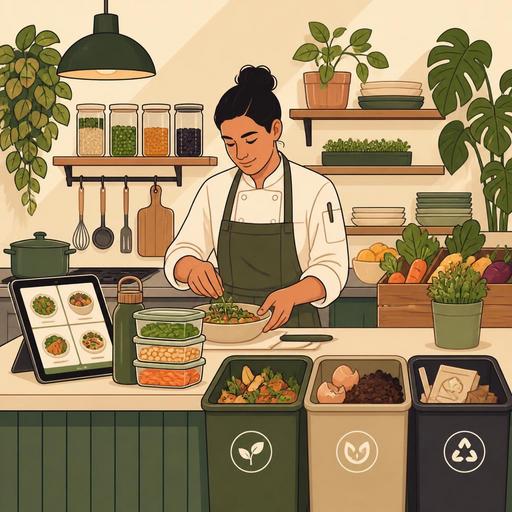
A Plan to Implement in the First 90 Days for a Zero-Waste Restaurant
The zero-waste restaurant approach is not only an environmental stance; it is also a powerful management model for cost control, operational discipline, and a more consistent customer experience. The first 90 days in particular are decisive for turning well-intentioned goals into daily operations. What matters in this period is not switching to a flawless system all at once, but aligning kitchen, service, purchasing, and menu decisions around the same goal.
Many businesses begin the zero-waste journey with grand statements, but because they can't regularly track which product goes to the bin and why, which portion comes back too large, or which prep step produces waste amid the daily rush, they soon lose motivation. Yet when a clear plan is set for the first 90 days, the source of waste becomes visible and the team more easily embraces which behavior truly makes a difference.
First 30 Days: Don't Try to Reduce Waste Before You Can See It
In the first stage, the goal is not to change everything immediately, but to make visible where, when, and for what reason waste occurs. The losses most frequently encountered in a restaurant are usually concentrated at three points: prep waste, stock that goes to the bin due to spoilage, and excess portions returned from the plate.
For example, in a kitchen working mainly with vegetables, if chopping standards aren't clear, the same product is used with different efficiency by different staff. One cook may discard the broccoli stem entirely, while another may use it for soup or a side dish. Similarly, in a business with breakfast service, if the daily production plan isn't based on reservation and past demand data, the loss from products left sitting out grows quickly.
In these first 30 days, it is helpful to set up the following observation system:
- Categorize the waste: prep waste, spoilage, incorrect production, items returned from the customer's plate, products nearing expiry.
- Keep a short record each shift: note which product, in what quantity, and for what reason it turned into a loss.
- Examine the best-selling and the most-wasted products side by side: some menu items may seem very popular yet produce unnecessary waste at the prep stage.
- Check portion consistency: regularly returned side dishes or unfinished accompaniments are a sign that the recipe needs revision.
Here, digital menu and order data provide important support. Knowing which product is preferred at which hours makes it easier to plan production based on real demand rather than guesswork. This way, more controlled prep can be done, especially on items with high end-of-day loss.
Days 31-60: Redesign the Menu and Purchasing Together
The zero-waste goal isn't solved in the kitchen alone; menu engineering and purchasing discipline must be handled together. In the second 30 days, the focus is on establishing the balance between product variety and operational sustainability.
When a restaurant's menu is too broad, low-turnover raw materials in particular sit in stock. This increases the risk of spoilage. For example, opening a separate supply line for a special sauce base used in only two dishes may create a sense of variety on the menu but cause waste in the background. By contrast, a smart menu design that uses the same main ingredient across different dishes both increases purchasing power and speeds up stock turnover.
Concrete steps you can implement at this stage
- Identify low-turnover products. Review dishes that sell little per week but are prepared regularly.
- Create a shared ingredient pool. Prioritize sauces, side dishes, and main raw materials that can be used across multiple products.
- Bring seasonality into menu decisions. Products well-supplied in season increase both quality and availability.
- Consider portion alternatives. Formats such as a lunch service, a light menu, or a sharing platter can reduce plate waste.
- Standardize prep recipes. Waste control isn't lasting until gram weights, cutting styles, and storage times are clarified.
For businesses using a QR menu infrastructure, there's an important advantage here: because menu updates aren't as costly and slow as with a printed menu, it's possible to quickly revise low-performing or high-waste products. Moreover, solutions such as a temporarily featured "dish of the day" make it easier to use up on-hand products in a controlled way.
Days 61-90: Bring the Team, the Guest, and Operations Around the Same Language
By the end of the first two months, seeing the data and simplifying the menu provide significant progress; but for durability, team behaviors need to become standardized. The third 30 days is the period for turning the zero-waste approach into a company culture.
In the kitchen, even the best plan isn't sustainable if the team doesn't understand its purpose. For example, telling staff "don't throw this away" is not enough on its own. It must be clear how each product is to be stored, which prep leftover is to be used in which recipe, and in which situation a disposal decision will be made for food-safety reasons. Zero waste is not random reuse; it is a disciplined and safe-use practice.
The service team is also part of this process. The first people to observe the side dishes a guest regularly doesn't finish are often the servers. If this feedback is systematically relayed to the kitchen, improvements are made with real service data instead of theoretical assumptions. For example, if bread service, large side dishes, or automatically served sauces frequently stay on the table, offering them on request rather than as a default can make a serious difference.
A 15-minute weekly checklist for the team
- Which product went to the bin most this week?
- Was the main cause spoilage, incorrect prep, or low sales?
- On which dish is there a signal of excess portions?
- Which product ran out at the last minute, causing unnecessary panic purchasing?
- Which single change will be tested next week?
At this point, being able to track order management, the reservation flow, and sales data in one place makes the manager's job easier. Seeing the expected rush more accurately enables more realistic planning of prep quantities. Especially during fluctuations tied to weekends, special days, or the weather, data-supported planning reduces the risk of overproduction.
Make the Zero-Waste Goal a Management Routine, Not a Project, in the Kitchen
The biggest mistake in the zero-waste restaurant approach is treating it like a short-term campaign. Yet real progress begins at the point where purchasing, prep, menu design, the service flow, and daily reporting are connected to one another. By the end of the first 90 days, not all problems may be solved; this is normal. What matters is that you now know which loss occurs where and that you've set up a mechanism for intervention.
Successful businesses generally stand out not with very complex systems, but with a regular decision rhythm. Looking at the same few questions every week, tracking the same product groups, and making small but measurable changes makes a big difference in the long run. Making a single side dish request-based on the menu today, removing a low-turnover product from the menu tomorrow, and simplifying a prep recipe the following week add up and make operations healthier.
In conclusion, sustainability is not just a value described in the window; it is a business capability that becomes visible through accurate data, a clear process, and disciplined implementation. Your restaurant doesn't have to be flawless in the first 90 days; but it does have to transition into a structure that wastes less, purchases more in a controlled way, and manages its menu more consciously.
Restomas, by making the menu and order flow more visible, can support you in managing zero-waste goals in alignment with daily operational decisions.
