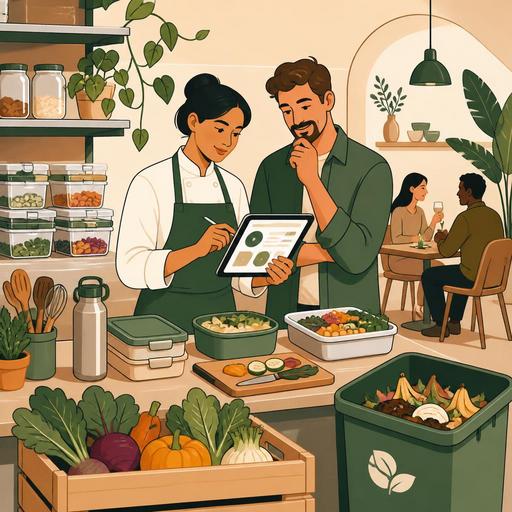
A First-90-Days Implementation Guide for the Zero-Waste Restaurant Transformation
The zero-waste restaurant goal is not only an environmental stance; it is also a practical way to build cost control, operational discipline, and a more consistent customer experience. But for many businesses, the problem is not in the intent, but in the starting plan. When questions such as "Where should I start?", "The kitchen first, the menu, or purchasing?", and "How do I get the team to adopt this?" go unanswered, the sustainability goal quickly falls off the agenda. In this article, we will cover a realistic zero-waste road map that restaurants can implement in the first 90 days.
The aim here is not to build a flawless system all at once; it is to make visible where waste is generated, achieve quick wins, and turn this into a lasting routine. Especially when menu management, order flow, portion standards, and stock tracking are supported by digital tools, sustainability ceases to be an abstract slogan and becomes a measurable part of daily operations.
1. First 30 Days: Make Waste Visible
The first step of the zero-waste journey should not be guessing, but tracking waste by categorizing it. In many restaurants, the phrase "there's a lot of waste" is used; but it is not clear whether this is prep waste, plate waste, spoilage, or wrong production. If the problem is not clear, the solution will not be clear either.
Track waste under four headings
- Prep waste: vegetable cleaning, meat trimming, wrong cuts, excessive pre-preparation.
- Spoilage-related loss: products past their use-by date, stored incorrectly, or left on hand without demand.
- Overproduction: soups, sauces, garnishes, and cooked main items left over at the end of the day.
- Plate waste: portions the customer did not finish, disliked pairings, excess garnish.
During this period, the chef, the purchasing manager, and the dining-room team must be on the same page. For example, if a cafe consistently has the same sandwich bread left over at the end of the day, the problem may not be only in purchasing; the product's visibility on the menu, the portion balance, or demand forecasting may also play a role.
Set up a simple daily log system. Which product went to waste and for what reason, on which shift, and at which station was it repeated? These records can be kept manually at first; but seeing order, stock, and menu data in one place provides serious clarity to the business. In businesses using a digital menu and order management, it is faster to notice which products are preferred less, at which hours overproduction occurs, and which products take up unnecessary space on the menu.
2. Days 31-60: Turn the Menu into a Structure That Reduces Waste Rather Than Producing It
In many restaurants, the root cause of waste begins not in the kitchen, but in the menu design. Broad menus that require very different raw materials, low-turnover products, and unclear portion standards create stock pressure. In the zero-waste approach, simplifying the menu is often the most effective step.
Menu engineering and sustainability must be considered together
For example, keeping in the same kitchen both a special sauce that sees low demand and a garnish used in only a single dish creates a waste risk as much as a cost. Instead, it is healthier to build a structure that draws on shared raw materials, can be used across different dishes, and adapts to the seasonal flow.
- Identify low-selling products. Re-evaluate products that stay on the menu only because "the chef loves them."
- Increase cross-use areas. Plan a product not for a single recipe, but across different dishes.
- Establish a portion standard. If the same plate comes out with different gram weights on different shifts, waste is inevitable.
- Offer options in a controlled way. Unlimited add-and-remove rights for every product can make operations harder.
Businesses using a QR menu infrastructure are at an advantage at this stage. Product descriptions can be updated without waiting for a printed menu, out-of-season products can be removed quickly, and alternative garnish or portion options can be offered in a controlled manner. This both reduces wrong expectations and lets the kitchen work with a more predictable order flow.
Consider a concrete example: you have a starter that does not sell often during evening service but is laborious to prepare. If the ingredients opened for this product cannot be carried over to the next day safely, its presence on the menu may be creating an operational burden rather than brand value. In such cases, revising the product's recipe, offering it only on certain days, or removing it entirely is the right decision for sustainability.
3. Days 61-75: Synchronize the Purchasing, Stock, and Production Plan
The zero-waste goal cannot be left only to the kitchen team's attention. The disconnect between purchasing and the sales rhythm is one of the most common causes of waste. A product may have been bought at a good price; but if it was not bought in the right quantity, the advantage quickly turns into a loss.
At this stage, you need to give clear answers to the following questions:
- Which products should be planned not weekly but daily or by shift?
- Which raw materials should be ordered flexibly according to seasonal fluctuations?
- For which products should a minimum stock level be defined?
- Which preparations should be made according to the actual order flow rather than a forecast?
For example, overproducing in brunch service by expecting high demand can lead to serious plate and production waste at the end of the day. Instead, past order data, reservation density, and hourly sales trends should be evaluated together. Businesses that track reservations and order flow digitally can plan preparation quantities with more consistent signals rather than rough guesses.
The goal here is not to "hold no stock at all." The goal is to close the gap between unnecessary safety stock and the real operational need. Products that do not sell well in particular need to be handled with options such as smaller packaging, more frequent supply, or removal from the menu.
4. Days 76-90: Involve the Team in the Process and Explain It to the Guest the Right Way
Sustainability projects often start well but fall apart because they do not turn into a team habit. To prevent this, position the zero-waste approach not as an "extra task," but as the standard of daily work.
Define clear rules the staff can apply
- How usable by-products will be separated during prep.
- The date- and time-labeling standard for opened products.
- Which products will be reported at the end of a shift.
- How products showing plate waste will be noted by the dining-room team.
- How unnecessary single-use consumption will be reduced in customer requests.
The dining-room team is also part of this transformation. If a guest consistently leaves a particular garnish unfinished, the person who carries this to the kitchen is often the server. Likewise, details such as "extra napkins," "single-use cutlery," and "packets of sauce," though they look small, affect total consumption.
On the guest-communication side, a transparent and simple approach is more effective than a didactic tone. Explanations such as "We use seasonal products," "We prepare some products in limited quantities," and "We offer portion options" manage expectations correctly. Giving clear information about ingredients, allergens, portions, and product availability within the QR menu both reduces wrong orders and prevents unnecessary re-preparation in the kitchen.
What Should You Measure at the End of 90 Days?
You do not need to have built a flawless zero-waste system at the end of the first 90 days. But you should clearly see in which areas improvement has begun. The following headings must be on the agenda of your management meeting:
- The top 10 products or ingredients that generate the most waste
- The impact of products removed from or revised on the menu
- The product groups with the highest plate waste
- Recurring error points by shift
- Deviations between purchasing quantity and actual consumption
This evaluation takes sustainability out of being a campaign and turns it into a business reflex. The real value is improving the quality of decision-making as much as reducing the product that goes to waste. Because restaurants that reduce waste are generally the ones that manage a simpler menu, buy more accurately, plan better, and meet guest expectations more clearly.
The zero-waste journey advances not with grand promises, but with small but regular operational decisions. If you set up a structure that lets you see menu, order, reservation, and operational data at a glance, it becomes far easier to make sustainability goals a natural part of daily management; and Restomas can offer a simple starting point for restaurants that want to build this visibility.