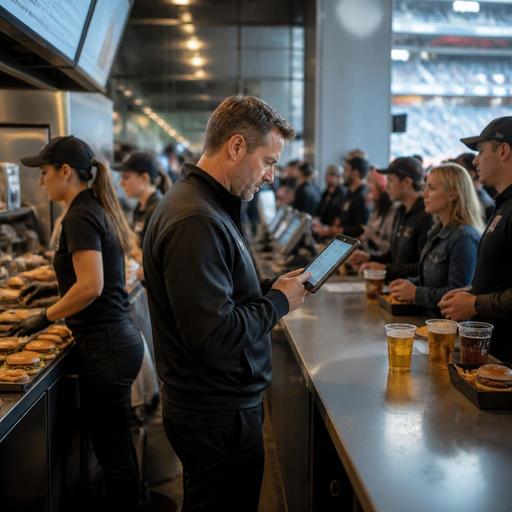
Peak-Hour Food Order Management for Stadiums and Concert Venues
Peak-hour food order management for stadiums and concert venues is different from ordinary restaurant rush service. Demand arrives in sharp waves, guests have limited patience, and the timing of orders is tied to halftime, intermission, gates opening, and crowd movement. For operators inside stadiums, arenas, and concert food courts, success depends less on broad marketing ideas and more on disciplined execution: simplified menus, clear kitchen routing, fast payment, and staff who know exactly what happens during each surge.
Whether you run a permanent concession stand, a premium lounge kitchen, a mobile bar, or a cluster of branded food counters, the challenge is the same: serve a very large number of people in a very short window without creating bottlenecks that damage revenue and guest satisfaction. A digital operating setup can help, but only when it supports a realistic service plan.
Design the menu for speed, not for variety
In high-volume event environments, every extra decision slows the line. The best peak-hour menus are built around items that can be assembled quickly, held safely for short periods, and understood instantly by guests scanning options under time pressure.
A practical approach is to separate the menu into three groups:
- Core fast movers: items with predictable demand that can be produced repeatedly with minimal customization.
- High-margin add-ons: drinks, snacks, sides, and simple upgrades that increase basket size without slowing production.
- Limited-complexity specialty items: a small number of products that differentiate the venue but do not overwhelm the kitchen.
For example, a concert venue burger stand may perform better with a tight menu of one classic burger, one cheeseburger, one plant-based option, fries, canned drinks, and two combo bundles than with a long list of toppings and made-to-order variations. The goal is not to remove choice entirely, but to protect throughput when hundreds of guests arrive at once.
Digital menus make this easier because operators can hide low-stock items, pause slow-moving products, adjust modifier visibility, and feature best-selling combos during the busiest periods. Instead of printing static boards that stay unchanged throughout the event, teams can adapt the offer as inventory and queue conditions change.
Build order flow around event timing
Many venue operators think in terms of lunch or dinner rush, but stadiums and concert venues work in waves. The biggest mistakes happen when staffing, prep, and ordering channels are not aligned with the event schedule.
Break the service window into clear phases:
- Pre-entry period: guests arrive in batches and often want quick drinks and portable food.
- Pre-show or pre-kickoff period: demand increases as guests settle into seats.
- Intermission or halftime surge: the most compressed and operationally sensitive ordering period.
- Late-event period: selective demand for drinks, snacks, and grab-and-go items.
- Exit period: limited but potentially valuable final transactions if service points remain efficient.
Each phase should have its own service rules. During halftime, for instance, the menu may need to shift automatically to the fastest items only. A fried chicken counter might temporarily disable slower basket configurations and push pre-set meal bundles instead. A premium suite kitchen might route drinks and packaged snacks separately from hot food so one station does not block another.
This is where digital order management matters. If mobile ordering, QR ordering, or counter ordering all feed into the same kitchen without prioritization rules, the system creates confusion instead of speed. Operators need clear routing by station, item type, and production time. Hot line items should not wait behind bottled drinks, and bar prep should not be buried under food tickets.
Reduce queue friction before it becomes a service failure
Long lines do not begin at the kitchen. They usually begin with unclear menus, slow payment, poor pickup organization, or guests asking staff basic questions that should already be answered. In a venue setting, small delays multiply quickly because foot traffic is so dense.
To reduce queue friction, focus on the guest journey from decision to pickup:
- Show concise menus: guests should understand top items in seconds.
- Use clear product naming: avoid internal shorthand or overly creative labels.
- Display allergen and key dietary info: this reduces hesitation and repeated staff explanations.
- Group items logically: mains, combos, drinks, and snacks should be easy to scan.
- Create dedicated pickup zones: guests should know exactly where to wait after ordering.
- Separate problem resolution from pickup: refunds, substitutions, and payment issues should not block completed orders.
Consider a stadium concourse with several food brands side by side. If each stand handles ordering, payment, and pickup differently, guests hesitate and staff spend valuable time giving directions. A more consistent digital ordering structure across stands can reduce confusion, especially when guests are rushing back to their seats.
QR menus and mobile ordering are especially useful when they reduce decision time before the guest reaches the counter. They work best when the venue keeps the interface simple, limits unnecessary modifiers, and makes pickup instructions obvious. The technology should shorten the path to food, not add another layer of complexity.
Train staff for surge roles, not just job titles
Peak-hour success depends on role clarity. In event venues, generic training is rarely enough because the service window is short and the margin for hesitation is small. Staff should be trained for surge roles tied to the actual flow of orders.
Instead of thinking only in terms of cashier, cook, and runner, define operational roles such as:
- line guide: helps guests choose quickly and directs them to the correct ordering point
- expediter: checks order completeness and manages handoff speed
- stock responder: refills packaging, drinks, condiments, and grab-and-go items before shortages halt service
- digital order monitor: watches incoming order channels and flags bottlenecks early
- exception handler: resolves failed payments, missing items, and guest complaints away from the main line
For example, a concert venue with self-order and counter-order traffic may assign one team member to monitor incoming digital tickets and temporarily pause certain modifiers when the grill station is overloaded. Another employee may focus only on staging pickup bags in alphabetical or numerical order. These are small decisions, but they prevent the service team from collapsing into reactive chaos.
Pre-event briefings should also include practical thresholds. What happens when fries run low? Who removes an unavailable item from the menu? When do combo offers replace individual item promotion? Who decides whether to close one ordering channel temporarily? Clear answers reduce panic during the busiest 15 minutes of the event.
Use live menu control and post-event review to improve each service cycle
Venue operations improve when managers treat every event as a repeatable learning opportunity. The most effective teams do not just survive the rush; they review what slowed them down and adjust the next event accordingly.
After each event, review questions such as:
- Which items created the most production delays?
- Which modifiers caused confusion or remakes?
- Where did the longest queue actually form: ordering, payment, kitchen, or pickup?
- Which products stocked out too early?
- Did staff know when and how to update item availability?
- Were digital orders routed to the right stations?
This review is where menu management and operational technology come together. If one premium sandwich repeatedly slows the line during halftime, it may belong only in pre-event ordering windows. If bottled drinks account for a large share of transactions, they may need a separate pickup lane or a dedicated express stand. If certain sections of the venue order heavily through mobile channels, staffing can shift to match that pattern.
Platforms like Restomas can support this kind of operation by making it easier to update digital menus quickly, organize ordering flows, and keep guest-facing information aligned with real kitchen conditions. The value is not in adding more screens, but in giving teams more control during the moments that matter most.
For stadiums and concert food venues, peak-hour performance is won through simplification, routing discipline, and fast adjustments under pressure. Operators who design menus for speed, align service with event waves, and train staff around surge roles can protect both revenue and guest experience when the crowd arrives all at once.
If you are refining event-day food operations, Restomas can help you organize digital menus and order flow in a way that fits real venue pressure.
