Peak-Hour Order Management for Stadium and Concert Food Venues
Peak-hour order management for stadium and concert food venues is not the same as running a typical restaurant rush. Demand arrives in sharp waves before gates open, during halftime, between sets, and immediately after a headline moment. Guests are in a hurry, lines build fast, and every delay affects both revenue and the overall event experience. For operators, success depends on simplifying the menu, reducing decision time, coordinating staff, and keeping order flow visible from the guest screen to the pickup counter.
In a stadium concourse or concert arena, guests are rarely browsing casually. They want to understand options quickly, place an order with confidence, and receive food without missing the event. That makes digital ordering, clear menu structure, and operational discipline especially important. The goal is not just to serve more orders, but to serve the right orders with fewer bottlenecks.
Why event venues face a different kind of rush
Traditional restaurants often deal with a gradual build in demand. Stadium and concert venues face compressed windows where hundreds of guests may order within minutes. A burger stand near a popular entrance may stay quiet for a period, then suddenly fill with guests just before kickoff. A beverage counter may spike during an intermission. A dessert kiosk may become busy after the final act.
These rushes create three predictable risks:
- Decision bottlenecks: guests pause too long at the menu board or ordering screen.
- Production bottlenecks: the kitchen or prep station cannot produce the most popular items fast enough.
- Handoff bottlenecks: completed orders pile up because pickup zones are unclear or staff are answering repeated guest questions.
Operators who treat these as separate problems can design better solutions. A shorter menu may solve decision delay. Batch prep may solve production delay. Numbered pickup zones or digital order status may solve handoff confusion.
Build a menu for speed, not for variety
One of the most effective ways to improve peak performance is to redesign the event menu around speed. This does not mean reducing quality. It means presenting items in a way that shortens ordering time and supports reliable execution.
Focus on high-throughput items
During major event windows, menus should favor items that can be assembled quickly, held safely for short periods when appropriate, or produced in repeatable batches. For example, a venue may offer a smaller game-day menu than its full hospitality menu. Instead of many burger variations, it may feature one standard cheeseburger, one chicken option, one vegetarian item, a fries add-on, and a few packaged beverages.
This approach helps in several ways. Guests make decisions faster. Staff memorize the menu more easily. Prep teams can stage ingredients with less complexity. Inventory is easier to track during the event.
Use clear categories and direct item names
At event venues, guests should not have to decode the menu. Group items into obvious categories such as mains, snacks, drinks, and combos. Keep names short and descriptive. If an item is spicy, meat-free, or includes a common allergen, say so clearly. If a combo includes fries and a drink, make that visible at a glance.
Digital menus can help by placing best-selling items first, showing strong photos only where they genuinely improve decision speed, and hiding unavailable items in real time. This matters when a popular sandwich sells out during halftime and staff need the menu to update immediately rather than explain the issue to every new guest in line.
Prepare the kitchen and service line for demand waves
Event food operations work best when prep is aligned with predictable crowd movement. The busiest venues usually know when their major surges happen. The mistake is not the rush itself; it is failing to stage labor and product for it.
Create a wave-based prep plan
Break the event into time blocks: pre-entry, first peak, mid-event lull, halftime or intermission, second peak, and exit period. Then define what each station must have ready before each wave. A fry station may need baskets staged before halftime. A beverage counter may need pre-cooled stock and backup cups at arm's reach. A hot food line may need buns opened, wrapped items organized, and packaging ready.
A practical method is to assign one supervisor to monitor the next 15 to 20 minutes rather than the current line only. That person can trigger replenishment before a stock gap becomes visible to guests.
Separate production from guest-facing tasks
When possible, divide staff into production roles and service roles. If the same person is taking orders, answering questions, assembling food, and calling pickup numbers, speed drops quickly. A better setup might include:
- One team member guiding guests to the ordering point or QR menu
- One team member focused on payment or order confirmation
- One or more staff on dedicated assembly
- One handoff staff member managing pickup and guest questions
This structure reduces task switching, which is a major source of mistakes during short, intense rushes.
Reduce queue friction with digital ordering and pickup clarity
In event venues, the line is not just a waiting problem. It is also a perception problem. Guests become anxious when they cannot tell whether the line is moving, whether an item is available, or where to collect their order. Digital systems can reduce that uncertainty if implemented simply.
Use QR ordering where it genuinely helps
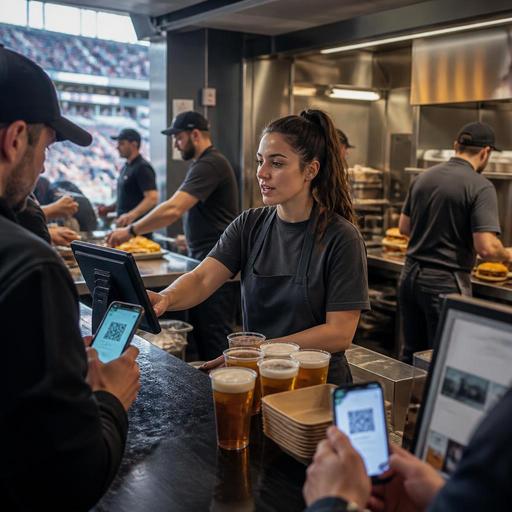
QR menus and mobile ordering can work well in stadium seating areas, premium lounges, and high-traffic concourses where guests prefer to avoid standing in line. A guest scans, sees only items available at that location, orders quickly, and receives a clear pickup instruction. This is especially useful when different stands offer different menus or when beverage-only stations need a faster path than hot food counters.
The key is operational follow-through. If guests order digitally but still crowd the counter asking for updates, the benefit disappears. Order status visibility and specific pickup messaging are essential.
Make pickup rules obvious
Pickup should be designed as carefully as ordering. Use simple order identifiers, separate waiting from collection space, and train staff to call orders consistently. If possible, define pickup by order number or name, not by item description. In noisy concert settings, visual order status can be more reliable than voice alone.
For example, a concession stand could direct guests to order on their phones, prepare orders on a kitchen display, and route finished orders to a dedicated pickup shelf with a staff member confirming handoff. That setup reduces crowding at the payment area and keeps the assembly zone protected from guest interruption.
Train staff for concise communication under pressure
Peak-hour success depends as much on communication as on technology. In loud, crowded venues, long explanations slow everything down. Staff need short, repeatable phrases and a clear escalation path when something goes wrong.
Train teams to answer common questions in one sentence where possible: what is sold out, where pickup happens, which line is fastest, and whether substitutions are allowed. If mobile ordering is available, front-line staff should know exactly how to direct a guest to it without confusion.
Pre-event briefings should also cover exception handling. What happens if an item runs out? Who updates the menu? Who approves a replacement? Who handles a delayed order? These decisions should not be invented in the middle of intermission.
- Before doors open: confirm menu availability, device readiness, packaging stock, and staff positions.
- Before each peak wave: restock top sellers, clear pickup space, and reassign float staff if needed.
- After each peak wave: review bottlenecks quickly while they are still fresh.
Over time, these short reviews help operators refine staffing, menu design, and station layout for future events.
Turn event-day lessons into a repeatable operating system
The best stadium and concert food venues do not rely on heroic effort alone. They build repeatable systems for menu control, order visibility, and labor coordination. After each event, review which items sold fastest, where delays occurred, which stations created backups, and when guest questions increased. Use those observations to adjust the next event's menu, prep list, and staffing map.
Even small changes can make a real difference: removing a slow-selling item, moving a pickup shelf, simplifying combo choices, or updating the digital menu when stock changes. Platforms like Restomas can support this kind of operational discipline by helping venues manage QR menus, order flow, and real-time menu updates in one connected process.
When event demand arrives in waves, speed comes from preparation, clarity, and control. The venues that perform best are the ones that make ordering easier for guests and execution easier for staff.
